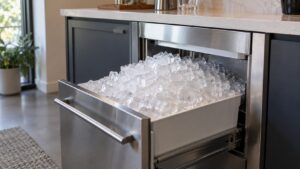
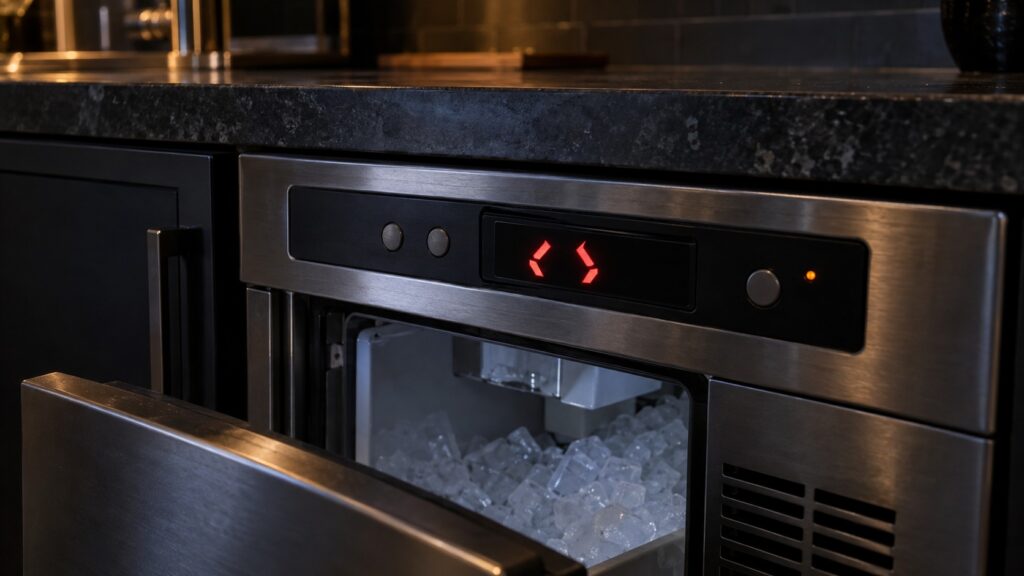
A U-Line E1 error code means thermistor 1 is open. Its three neighbors follow the same pattern: E2 is thermistor 2 open, E5 is thermistor 1 shorted, and E6 is thermistor 2 shorted. Four codes, two sensors, two kinds of electrical failure. Nothing in that group describes ice, water or a compressor. Each one says the control board asked a temperature sensor for a reading and got an answer that cannot be a temperature.
What does the U-Line E1 error code mean?
A thermistor is a resistor whose resistance changes predictably with temperature. The board does not measure degrees directly; it measures resistance and converts. That conversion has a floor and a ceiling. Somewhere near infinite resistance there is no sensor there at all, and somewhere near zero the two leads are touching each other. Readings outside those limits are not cold readings or hot readings — they are impossible readings, and the board rejects them instead of acting on them.
E1 is the rejection notice for the first sensor in the open direction. The practical meaning for an owner is narrow and useful: the machine has not decided anything is wrong with the refrigeration system. It has lost its ability to judge, and it stopped rather than run blind.
Open or shorted: why does the difference get its own code?
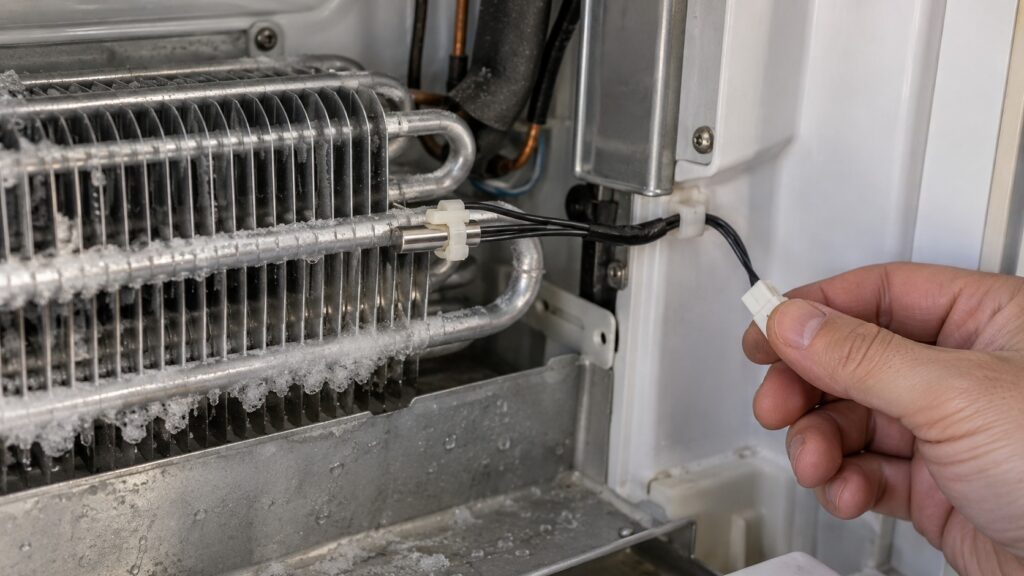
Because the two failures come from different places and are found in different ways. An open circuit is almost always mechanical damage along the path: a lead pinched when a panel went back on, a pin backed out of its housing, a splice that corroded in a damp cabinet, or a sensor that cracked. A short is usually contamination or crushing: moisture bridging two pins inside a connector, insulation worn through where the harness crosses a metal edge, or a sensor body that has been compressed against a bracket.
That is why E5 and E6 have a seasonal habit in humid rooms and outdoor installations, while E1 and E2 tend to appear after the machine has been moved or serviced. The codes are not ranked by severity. A short is not worse than an open; it is a different failure of the same part.
Which sensor is thermistor 1 and which is thermistor 2?
The code list on this site numbers the sensors and does not name their positions, and that is worth taking literally rather than guessing around. The numbering belongs to the wiring of a particular model, so thermistor 1 on one cabinet is not necessarily in the same place as thermistor 1 on another. Undercounter ice machines generally carry one sensor watching the ice-making surface and another watching the cabinet or storage area, but which of those is wired to the first input is a question the model’s own documentation answers.
What follows from this is practical. A code number is not a part number. Ordering a sensor because the display said E2 skips the step where somebody confirms which sensor the second input belongs to on that model string, and a thermistor ordered from a guess is the most common wasted part on this family of machines.
What happens to ice production while the code is up?
The ice-making cycle on an undercounter machine is timed and ended by temperature. The board decides when a harvest should start and when the cycle has finished by watching a sensor, so a machine that cannot trust its sensors has no safe way to run a full cycle. Depending on the model and which input failed, that shows up as production stopping outright, as cycles that never finish, or as a machine that runs continuously and makes very little.
This is why a thermistor code is often reported as a production problem rather than a sensor problem. If your machine has slowed down without posting a code at all, the cause is usually elsewhere — start with slow ice recovery or with an ice maker not making ice, both of which cover the water, airflow and condenser side of the same symptom.
What can you check before calling for service?
The list is short, because a sensor circuit is not something an owner can test without a meter:
- Restart the machine at the breaker or the plug. Give it two minutes off. A code that clears and stays gone was a momentary read; one that comes back within a cycle is live.
- Note whether the number changes. A machine that shows E1 one day and E5 the next is describing a connector that moves, not two dead sensors.
- Look at the room, not the machine. Shorts follow moisture. A machine in a garage, a poolhouse or an outdoor cabinet that has been rained into is a different conversation from one under a kitchen counter.
- Clean the condenser if it is overdue. It will not fix a sensor code, but a machine that has been running hot for months is a machine whose harness has been baked, and the technician should know.
Do not open the cabinet to look for the sensor. On a built-in machine the harness runs beside mains wiring and the water circuit, and the sensor leads are thin enough that finding them by hand is how an open circuit gets created rather than found.
When does a thermistor code mean a service call?
As soon as it survives a restart. There is no owner-level fix for an open or shorted sensor circuit, and the three candidates — the sensor, the harness between it and the board, and the board input itself — are separated with a resistance measurement in a few minutes. Guessing between them costs the price of a part each time.
We are an independent repair company and not a factory service arm. Pricing starts from a diagnostic visit and we confirm the estimate before any work begins. Bring the model string from the rating plate and the exact code, and say whether the number has changed between visits to the kitchen.
The code pages for E1 and E2 carry the short definitions, the E3, E4, E7 and E8 codes cover the extra sensors on multi-zone cabinets, and ice maker repair is the service to ask for. You can schedule a visit online with the code to hand.