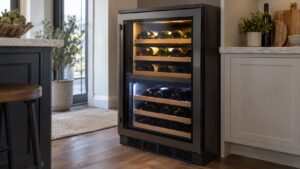
A U-Line wine fridge with dual or multi-zone capability, also sold under the Wine Captain name, divides a single built-in cabinet into two or more independently controlled temperature compartments. This lets a household store reds and whites at their own ideal temperatures in one appliance, or dedicate one zone to long-term preservation and another to ready-to-serve bottles. This page is independent, brand-neutral information intended to help owners understand and maintain these units; it is not affiliated with U-Line.
About U-Line wine fridges
Multi-zone U-Line wine fridges use a divided cabinet with separate insulated compartments, each with its own evaporator, sensor, and control logic, so the upper and lower sections can run at genuinely different temperatures rather than approximating a range with vents alone. This design suits collectors and serious enthusiasts who want long-term preservation temperatures for aging reds in one zone while keeping whites or sparkling wines chilled and ready to pour in another. Because each zone operates semi-independently, these units are mechanically more complex than single-zone coolers, with two separate cooling circuits or a shared compressor feeding two evaporator loops depending on the model tier.
The appeal of a multi-zone wine fridge is flexibility: a household can hold a case of full-bodied reds at a warmer cellar temperature in one section while keeping whites, rosés, and sparkling wines chilled and ready to serve just below in the same footprint, without needing two separate appliances. That flexibility comes with more parts that can individually fail, though, since a dual-zone cabinet effectively packs two smaller refrigeration systems — or one compressor serving two independently damped evaporator loops — into a single undercounter or column enclosure, along with the insulated divider that keeps the two zones from influencing each other’s temperature.
Signature features & technology
- Independent dual-zone (or multi-zone) temperature control, allowing separate setpoints for reds, whites, and sparkling wines in the same cabinet
- Convection Cooling airflow within each zone to keep temperature consistent from the top shelf to the bottom in that compartment
- Adjustable white or blue LED lighting per zone for display purposes without adding heat load
- UV-resistant glass door construction to protect stored bottles across both zones from light degradation
- Digital touch pad control allowing each zone’s setpoint to be adjusted independently, often with a cleaning-cycle indicator
- Vibration-dampening cabinet construction, particularly important for the long-term aging zone where sediment disturbance affects wine quality over years of storage
Common problems
- One zone drifting off its setpoint while the other zone performs normally, which typically points to a problem isolated to that zone’s evaporator, sensor, or damper rather than the whole unit
- Temperature bleed between zones, where the boundary shelf runs warmer or cooler than expected due to a failing zone divider seal or insulation gap
- Condenser dust buildup causing both zones to run warm simultaneously, since the compressor and condenser are typically shared even when the cooling loops are separate
- Digital control showing mismatched or frozen readings for one zone after a power interruption, often requiring a targeted reset of that zone’s control logic
- LED lighting failing in one zone independently of the other, consistent with a zone-specific wiring or driver issue
- Door seal wear near the zone divider causing localized condensation or frost right at the boundary between compartments
Maintenance tips
- Clean the shared front condenser grille regularly, since a dust-clogged condenser can affect both zones even when only one seems to be underperforming
- Check both door seals and the internal zone divider seal periodically, since dual-zone units have more sealing surfaces than single-zone coolers and more places for a leak to develop
- Set and verify each zone’s temperature independently after any power outage to confirm both compartments returned to their intended settings
- Avoid loading bottles in a way that blocks the internal vents feeding either zone’s convection airflow
- Keep the cabinet level, since an uneven installation can affect gasket contact differently across the two door sections or zones
- Note which zone is used for long-term aging versus short-term serving so any drift is easier to catch early through routine spot checks
When to call a technician
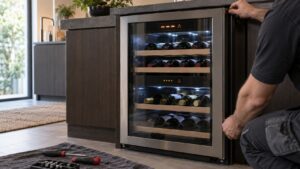
If one zone won’t hold temperature after cleaning the shared condenser and checking seals, if you notice temperature bleed between compartments, or if a zone’s control display stops responding, a qualified appliance repair technician should diagnose the specific zone. Dual-zone units require isolating which cooling circuit or sensor is responsible, which typically needs professional diagnostic tools. Because a multi-zone cabinet often represents a larger, more valuable collection than a single-zone cooler, it’s worth having any temperature irregularity investigated quickly rather than assuming it will self-correct, particularly for bottles being aged long-term in the warmer zone.
U-Line wine refrigerators are built and documented by the manufacturer in Milwaukee. For official specifications and owner documentation, visit the manufacturer at u-line.com.