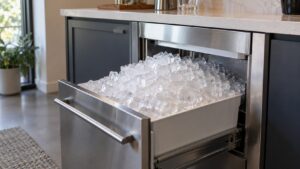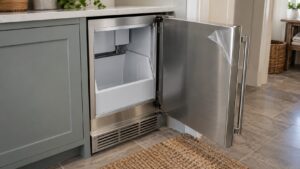

This guide covers U-Line Ice Maker Slow Ice with practical, technician-backed advice.
Slow ice recovery on a U-Line ice maker means the unit is still producing ice, just at a noticeably slower pace than it used to, or slower than the harvest cycle owners expect between batches. This is different from a machine that’s stopped making ice entirely, and the causes tend to be more mechanical and environmental than electrical. Working through the usual suspects in order will usually explain the slowdown.
Understanding the U-Line Ice Maker Slow Ice
Below, our specialists break down everything you need to know about the U-Line Ice Maker Slow Ice.
Likely causes of slow ice recovery in a U-Line ice maker
- Restricted water supply — a partially closed shutoff valve, kinked line, or a water filter nearing the end of its service life reduces flow into the reservoir and stretches out each harvest cycle.
- Condenser airflow blockage — like refrigeration units, U-Line ice machines pull air through a grille to reject heat; dust buildup there slows the refrigeration cycle and, with it, ice recovery time.
- High ambient temperature or poor clearance — an ice machine installed in a warm space or without adequate clearance around the cabinet has to work harder to complete each freeze cycle.
- Mineral scale on the evaporator plate — hard water can leave scale on the freezing surface over time, which insulates it slightly and slows how quickly each cycle forms ice.
- Variable speed compressor ramping behavior — the compressor is designed to modulate output to match demand, and if it’s staying at a lower speed than the load requires, recovery between batches will lag.
- Water temperature entering the unit — unusually warm incoming water takes longer to freeze each cycle, which shows up as slower recovery even though nothing in the machine has failed.
What you can check yourself
- Unplug the ice maker before opening any access panel or inspecting the water connection.
- Check that the water supply valve behind the unit is fully open and the line isn’t kinked or pinched behind cabinetry.
- Note the water filter’s install date if the unit uses one, and replace it if it’s overdue, since a clogged filter restricts flow gradually rather than all at once.
- Vacuum the front or bottom condenser grille to remove dust, pet hair, and lint that reduce airflow.
- Confirm the unit has the clearance called for in the installation instructions and isn’t boxed in by cabinetry on more sides than intended.
- Look at recent ice for any change in clarity or cube shape, since scale buildup on the freezing plate can affect both appearance and cycle time together.
- Watch the digital touch pad for any displayed problem after power is restored, since a persistent E-series code points to a component issue rather than a simple flow restriction.
When to call a technician
If supply, airflow, and clearance all check out and recovery is still noticeably slower than normal, the issue is likely inside the sealed refrigeration system or the compressor’s control logic, both of which require a technician with the proper tools to diagnose safely. A qualified appliance repair technician can test refrigerant charge, verify the water valve’s actual flow rate against factory ranges, and confirm whether the compressor is ramping correctly under load. If the slowdown showed up suddenly alongside an error code on the touch pad, that’s a strong signal to schedule service rather than keep waiting out the cycle.
How usage patterns affect recovery time
It helps to have a realistic baseline for how quickly a U-Line ice maker should refill after being emptied, since expectations set by a large commercial machine or a bigger residential unit don’t translate directly to a compact built-in model. Households that entertain frequently and empty the bin in a single evening are naturally going to notice recovery time more than households with steady, moderate use throughout the week, and that’s normal rather than a sign of a problem on its own. What matters more than the absolute speed is whether recovery has gotten slower relative to how the same unit performed under similar demand in the past.
Seasonal changes are also worth factoring in, since a kitchen that runs warmer in summer months — whether from ambient heat, more oven use, or simply a warmer household overall — can measurably slow an ice machine’s recovery even when nothing about the unit has changed mechanically. If slow recovery only shows up during the warmest part of the year and returns to normal once temperatures drop, that pattern points toward ambient conditions rather than a developing mechanical problem, and it’s useful information to share with a technician if the issue does eventually need a service visit.
U-Line ice machines are built and documented by the manufacturer in Milwaukee. You can confirm model details and manuals on the manufacturer’s site, u-line.com.