This guide covers U-Line Wine Fridge Zones Not with practical, technician-backed advice.
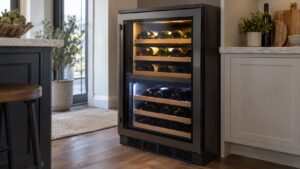
A dual-zone U-Line wine fridge is designed to keep two separate temperature ranges in the same cabinet, which is useful for storing reds and whites at their proper serving conditions. When the zones stop behaving independently — both drifting toward the same temperature, or one zone tracking the other’s changes — it usually points to something affecting the divider or the sensors rather than a total system failure.
Understanding the U-Line Wine Fridge Zones Not
Below, our specialists break down everything you need to know about the U-Line Wine Fridge Zones Not.
Likely causes of zones not holding separately in a U-Line wine fridge
- Compromised internal divider or seal — the barrier between zones is what keeps air from mixing; a gap, warped panel, or damaged seal at the divider lets temperature blend between the two sections.
- Blocked internal vents — bottles or storage racks placed against the vents that regulate airflow to each zone can throw off how independently each side responds.
- Sensor placement or problem — each zone reads its own sensor to decide how much cooling to apply, and a sensor reporting incorrectly can cause one zone to chase the other’s temperature.
- External door seal issues — if the main door’s gasket is compromised, warm air entering the cabinet affects the zone nearest the door disproportionately, making the two zones seem to converge.
- Overloading one zone — packing one section heavily changes its thermal mass and airflow pattern, which can pull its temperature closer to the neighboring zone’s setting.
- Control board zone logic problem — in less common cases, the board itself may not be applying independent setpoints correctly to each zone’s cooling element.
What you can check yourself
- Unplug the wine fridge before inspecting the internal divider, vents, or door seal.
- Inspect the divider between zones for visible gaps, warping, or a seal that’s come loose, since this is one of the more common and visible causes.
- Confirm each zone’s internal vents are clear of bottles or racking that could restrict airflow to the sensor or cooling element.
- Test the main door gasket with the paper-slip method around its full perimeter to rule out warm air infiltration affecting the near zone.
- Check that the setpoints on the digital touch pad are actually set differently for each zone, since a setpoint entry error can look identical to a mechanical problem.
- Rebalance bottle load between zones if one side is significantly fuller than the other, then monitor for a day to see if independence improves.
- Note whether an E-series code appears on the display, since a code tied to a specific zone sensor narrows down the cause considerably.
When to call a technician
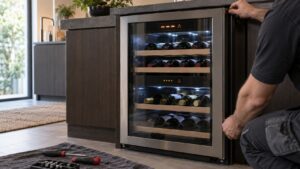
If the divider looks intact, the door seal passes inspection, and setpoints are correctly configured but the zones still track each other, the issue is most likely a sensor reading incorrectly or a control board that isn’t applying independent zone logic — both of which require diagnostic tools and board-level access. A technician can test each zone’s sensor output against actual measured temperature and determine whether the problem lies in the sensor, the wiring to it, or the board itself. Because opening the control housing or replacing a sensor involves working around live electronics and refrigerant lines, this is a repair to schedule with a qualified appliance technician rather than attempt independently.
Why dual-zone units are more prone to this specific complaint
A single-zone wine fridge only has one setpoint to maintain, but a dual-zone unit has to run two independent cooling profiles in the same cabinet while preventing them from bleeding into each other through the shared structure. That makes the internal divider one of the more mechanically important, and more easily overlooked, components in the entire cabinet. It doesn’t get much attention during normal use since it isn’t something owners interact with directly, which is exactly why a developing gap or seal failure there can go unnoticed until the zones have already started drifting toward one another.
It’s also useful to know that some convergence between zones during extreme ambient conditions, like a very hot room, can be a normal limitation rather than a problem, since the unit’s total cooling capacity is shared across both zones. If the zones separate normally again once room conditions return to typical, that’s a different situation from zones that stay merged regardless of the room temperature, and it’s worth noting which pattern you’re actually seeing before assuming a component has failed.
U-Line wine refrigerators are built and documented by the manufacturer in Milwaukee. Original documentation for these units is available from the manufacturer, u-line.com.