Everything that goes wrong with an undercounter freezer over years comes back to water — where it forms, whether it can leave, and what happens when it cannot. Sensible u-line freezer defrost drain maintenance is a short routine: keep the drain path clear, keep the door sealing, and know the difference between frost that is normal and frost that is reporting a fault.
How the water is supposed to move
Cold is produced at the evaporator, and moisture in the cabinet air freezes onto it. That is unavoidable — it is the same process as dew forming, at a lower temperature. A defrost cycle periodically warms the evaporator enough to melt that frost, and the water runs down a trough into a drain, along a tube, and into a pan near the compressor where the heat of the machine evaporates it away.
Every failure in this category is a break somewhere along that path. The defrost does not happen, or the water cannot get out, or it gets out and then cannot evaporate. Knowing the path is most of the diagnosis.
Reading the frost
A light, even coating over the evaporator area is a freezer doing its job. What is worth acting on:
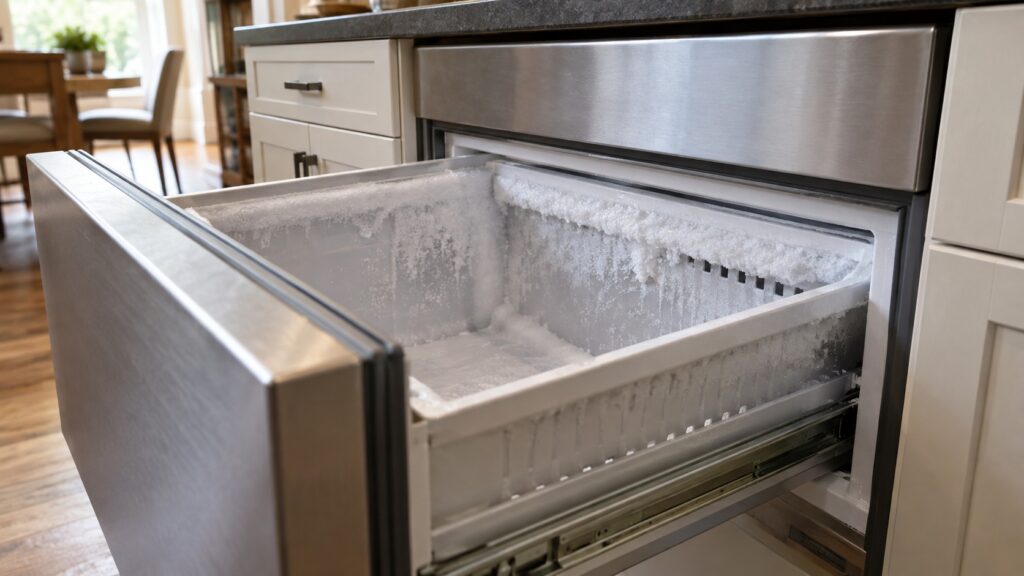
- A solid sheet of ice over the rear wall that returns after you remove it. The defrost system is not clearing the evaporator — heater, sensor, thermostat or control.
- Frost concentrated near the door, at the top or along one edge. That is humid room air entering through a failing seal, and it will point you at the exact spot.
- Frost building rapidly after a period of normal service. Something changed — a seal, a door left ajar regularly, or a defrost component.
- Frost on the food rather than the walls, in a sealed package. That is moisture already inside the package, not a cabinet fault.
Our heavy frost guide works through the causes in order once you have identified the pattern.
Clearing the drain
A blocked drain announces itself as water in the base of the cabinet, ice forming under the bottom basket, or eventually water on the floor in front of the unit. The blockage is usually a plug of ice in the drain tube, sometimes debris.
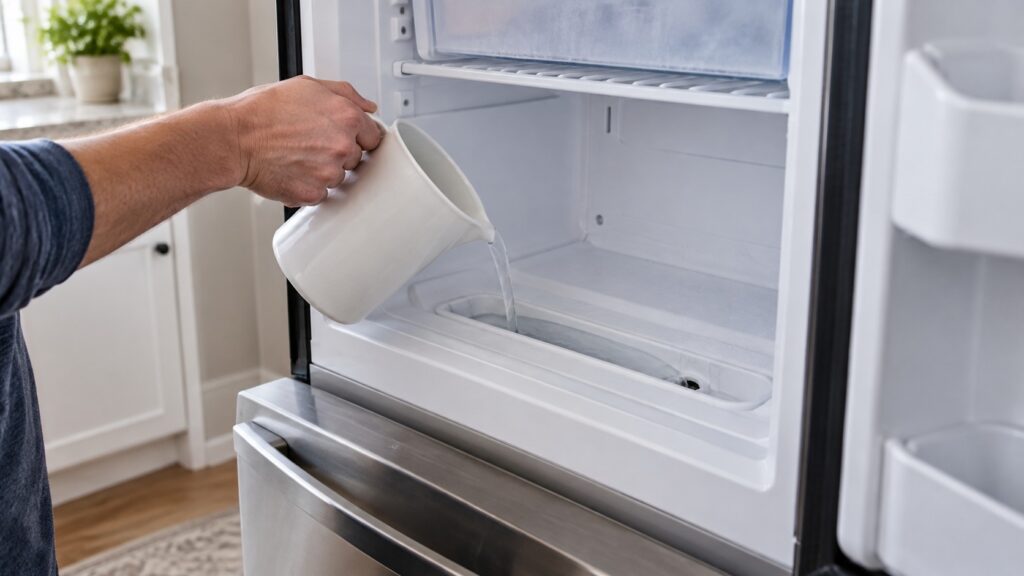
The approach is patience rather than force. Empty the cabinet, switch the unit off and let it stand with the door open until everything has thawed — several hours, with towels down. Hot water poured slowly into the trough will speed it, but never use a metal implement to chase ice down a drain, because the evaporator and the tubing behind it are thin and easy to puncture.
Once it runs clear, flush it with warm water and check the water is reaching the pan at the back. If the drain blocks again within months, something is causing it — a tube that has sagged into a trap, or a defrost cycle that is not warming enough to clear the drain itself.
The door, which decides how much frost you get
Most frost problems start at the door, because that is where humid room air enters. Close the door on a banknote and pull at several points around the edge; it should grip everywhere. Look for flattened sections, splits at the corners, and residue holding the gasket off the frame.
Check the door closes squarely, too. Undercounter units are often installed where people knock them with a foot, and hinges settle. A door that needs a push to seal will be left unsealed regularly.
And look at what is inside. A basket sitting slightly proud, or a package pushed forward, holds the door open by a fraction that is enough. Our door open too long guide covers the alarm side of the same problem.
The rest of the twice-yearly routine
- Clean the condenser behind the front grille. On a built-in unit this is the only air path it has.
- Check the drain pan at the back is not cracked or displaced, and that the area is not damp.
- Wipe the interior with a mild solution and dry it fully — moisture left behind becomes next month’s frost.
- Verify the temperature with a thermometer between packages rather than by the display.
- Listen for the fan, and confirm it stops when the door opens and starts again when the switch is pressed.
- Check the leveling, because a unit sitting out of level sends drain water to the wrong corner of the trough.
- Look behind the unit for a kinked or trapped drain tube, which is the commonest cause of a drain that keeps re-blocking.
Our convertible freezer maintenance guide covers the units that switch between freezer and refrigerator duty, where the frost behavior changes with the mode.
What maintenance will not fix
A defrost heater that has failed, a defrost sensor or thermostat that no longer triggers, a control that has stopped running the cycle, or an evaporator fan that has seized are parts rather than housekeeping. The symptom that points there is ice that returns quickly after a full manual defrost with a good door seal.
A unit that will not hold temperature at all, with a clean condenser and a sealing door, is a different conversation — our not holding temperature guide covers it.
When to call
Call when heavy ice returns after a full defrost, when the drain blocks repeatedly, when water reaches the floor, when the evaporator fan is silent, or when the cabinet will not hold temperature with everything else in order.
We are an independent repair company and not a factory service arm. Pricing starts from a diagnostic visit and we confirm the estimate before any work begins. U-Line freezer repair covers defrost, fans, seals, drainage and controls, and you can schedule a visit online.