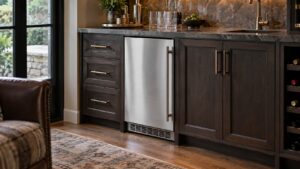
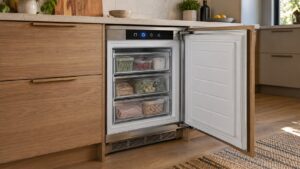
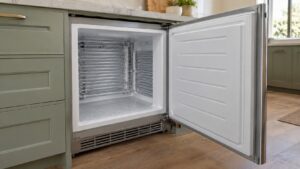
A U-Line freezer is a built-in, undercounter unit engineered to hold food at deep-freeze temperatures inside cabinetry rather than as a standalone chest or upright appliance. Many models in U-Line’s lineup are convertible, meaning the same cabinet can be switched between refrigerator and freezer operation through the control panel, giving homeowners flexibility as storage needs change. This is independent, brand-neutral information for owners troubleshooting or maintaining these units — it is not published or endorsed by U-Line.
About U-Line freezers
U-Line freezers appear across the 2000 Series, Modular 3000 Series, and higher-tier 3 Class and 5 Class platforms, typically as drawer-style or single-door undercounter units sized to fit a 15-, 18-, or 24-inch cabinet opening. Because a built-in freezer vents from the front and sits enclosed on the other sides, it depends heavily on unrestricted airflow at the base grille to reject heat from the compressor. Convertible models add a layer of control-board logic that reassigns the target temperature range and defrost cycle depending on whether the unit is set to freezer or refrigerator mode.
Freezers work their compressors harder than refrigerators of the same footprint because they hold a much lower setpoint, so the margin for error on ventilation and gasket condition is smaller. Homeowners often add a freezer drawer to a bar or outdoor kitchen specifically to keep ice cream, frozen appetizers, or vacuum-sealed proteins on hand without walking back to a main kitchen freezer, which means these units frequently see more door or drawer openings per day than a typical chest or upright freezer buried in a garage. That usage pattern is worth keeping in mind, since frequent opening is one more variable that can accelerate frost formation if the seal isn’t in top condition.
Signature features & technology
- Convertible refrigerator/freezer operation, letting a single undercounter cabinet switch modes through the digital control
- Variable Speed Compressor that ramps output up or down to hold deep-freeze setpoints efficiently rather than short-cycling
- Convection Cooling airflow to minimize the temperature gradient between the top and bottom of freezer drawers or shelves
- Digital touch pad control with temperature display and a condenser cleaning indicator
- Star-K Sabbath Mode on select models for observant households
- Soft-close, articulating hinges on door models; smooth full-extension slides on drawer models
Common problems
- Freezer running warm or failing to hold sub-zero temperatures, often traced to a dust-clogged condenser or a compressor that can no longer keep up with the load
- Heavy frost buildup inside the cabinet, which can indicate a failed defrost heater, a stuck defrost timer, or a door/drawer seal that no longer closes tightly
- Convertible mode switch not taking effect, leaving the unit stuck at refrigerator temperatures when set to freezer or vice versa, usually a control-board failure
- Drawer slides binding or dragging under a heavy custom panel and full load of frozen goods, which can also compromise the seal
- Ice forming around the door or drawer gasket, pointing to a seal that has hardened or warped over time
- Unusual clicking or humming at startup suggesting a failing compressor start relay or capacitor
Maintenance tips
- Clean the front condenser grille regularly since a freezer’s compressor works harder than a refrigerator’s and is more sensitive to restricted airflow
- Defrost manually if frost accumulates beyond roughly a quarter inch on models without automatic defrost, rather than letting it build up around the door
- Inspect and clean door or drawer gaskets periodically, since a compromised freezer seal accelerates frost formation faster than it would in a refrigerator
- Avoid overpacking drawer-style freezers to the point that items press against the gasket line and prevent a full seal
- Verify the cabinet has proper front-vent clearance per the installation specification, since freezers reject more heat than refrigerator models
- Note the mode setting after any power outage on convertible units to confirm it returned to the intended freezer or refrigerator configuration
When to call a technician
If the cabinet won’t reach freezer temperatures after cleaning the condenser and confirming the door seals properly, if a convertible unit won’t switch modes, or if you notice recurring frost buildup despite a good gasket, it’s time to bring in a qualified appliance repair technician. Defrost-system and sealed-system repairs on freezers involve refrigerant handling and electrical diagnostics best left to a trained professional. Because a freezer holds food at a much less forgiving temperature margin than a refrigerator, it’s also worth having a technician check performance sooner rather than later once symptoms appear, since a slow decline in cooling capacity can spoil frozen food well before the unit stops running altogether.
U-Line freezers are built and documented by the manufacturer in Milwaukee. For official specifications and owner documentation, visit the manufacturer at u-line.com.