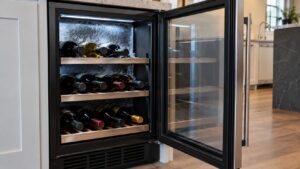

Choosing between a built-in and freestanding installation is one of the first decisions to make when adding a U-Line wine cooler to a home, and the two approaches have real differences in how the unit manages heat, where it can be placed, and what the installation process actually involves.
Understanding the U-Line Wine Cooler
Below, our specialists break down everything you need to know about the U-Line Wine Cooler.
What built-in installation means
A built-in U-Line wine cooler is designed to be enclosed on the sides and top by surrounding cabinetry, typically as part of a kitchen island, bar area, or custom cabinet run. These units are engineered with front-venting airflow, meaning the condenser draws in and exhausts air through the front of the unit rather than the sides or back. That front-venting design is what makes built-in placement possible in the first place — without it, an enclosed cabinet opening would trap heat around the compressor and condenser, causing the unit to overwork itself or overheat.
What freestanding installation means
A freestanding wine cooler is meant to stand on its own, typically with some open space around the back and sides for airflow, similar to a standalone refrigerator. Not every unit is rated for both installation styles, so it matters to confirm whether a specific model is designed as front-venting (built-in capable) or requires open clearance on multiple sides (freestanding only) before deciding where it will live in the home.
Key differences that affect the decision
- Ventilation clearance. Built-in models need proper clearance specifically at the front vent, while freestanding models generally need clearance on the back and sides instead.
- Placement flexibility. A freestanding unit can generally be relocated more easily since it isn’t tied to a specific cabinet opening, while a built-in unit is installed with a fixed footprint in mind.
- Cabinetry planning. Built-in installation typically requires coordinating cabinet dimensions and opening size in advance, often as part of a kitchen design or renovation project.
- Heat dissipation. Because built-in units vent through the front, the surrounding cabinetry doesn’t need to allow airflow, but the front vent itself must never be blocked by décor panels, kick plates, or stored items.
Practical considerations before installing
Whichever style you choose, confirming the unit is level once installed matters for both door sealing and internal component operation. It’s also worth checking that the electrical outlet is positioned appropriately and that, for built-in placements, the cabinet opening matches the exact dimensions specified for that model rather than a close approximation. A wine cooler installed in a cabinet opening that’s too tight can restrict the front vent’s airflow even if clearance guidelines were technically followed on paper.
Thinking ahead about future access
It’s also worth considering how easily the unit can be serviced or replaced down the line based on how it’s installed. A built-in unit set into custom cabinetry with a tight-fitting surround can be more involved to remove for service than a freestanding unit that simply slides out from an open space. That doesn’t mean built-in installation should be avoided, but planning for reasonable access during the initial design, rather than only after a repair need arises, saves a considerable amount of hassle later.
If there’s ever doubt about whether a specific U-Line wine cooler model is rated for built-in use, checking the venting design before installation avoids a situation where the unit is later found to be overheating or underperforming simply because it was installed in a way it wasn’t engineered for.
Getting your U-Line wine cooler fixed for good
Working through the points above resolves many cases on a wine cooler. If the problem behind “U-Line Wine Cooler: Built-In vs Freestanding Installation” persists after you have tried the safe checks here, an experienced U-Line technician can pinpoint the exact cause and complete the repair with genuine parts. Sealed-system, thermistor, and control-board work should always be left to a qualified refrigeration technician. Our specialists focus on U-Line wine coolers specifically, so diagnosis is faster and repeat visits are rarer.
For help with “U-Line Wine Cooler: Built-In vs Freestanding Installation,” our U-Line specialists are ready. Every repair is quoted from the actual problem, not a flat guess, and covered by a labor guarantee. You can book online any time, check the error-code library, or explore our U-Line repair services.
U-Line wine coolers are built and documented by the manufacturer in Milwaukee. You can confirm model details and manuals on the manufacturer’s site, u-line.com.