Outdoor kitchens are full of appliances that look like their indoor equivalents and are not. Shopping for u-line outdoor refrigeration means reading a specification sheet where several unfamiliar terms decide whether the unit survives its first winter, and where a wrong choice is not a matter of convenience but of a compressor running until it fails. Here are the words that matter.
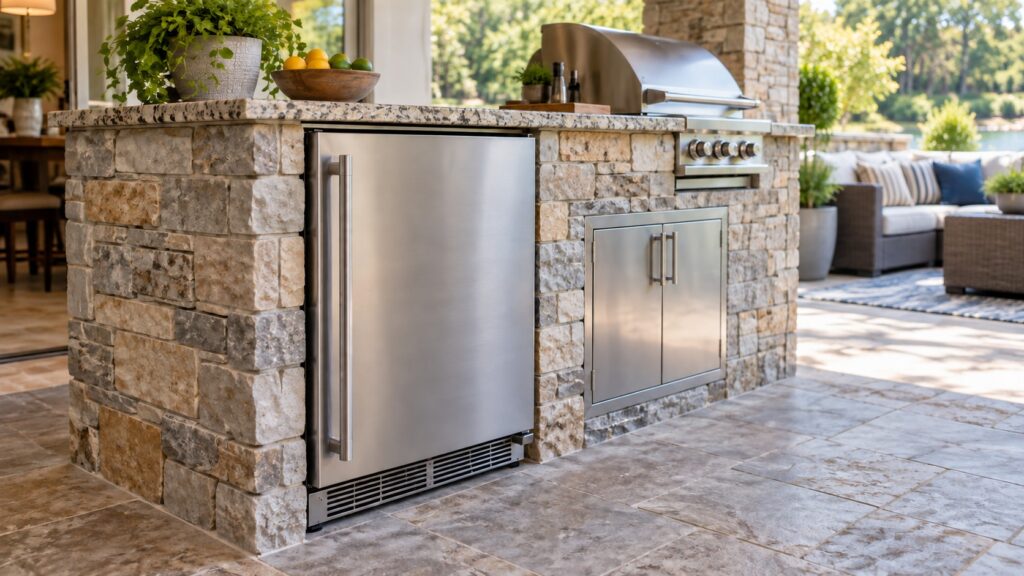
Outdoor rated, and why stainless is not the test
The single most expensive misunderstanding in this category is treating a stainless steel finish as proof an appliance belongs outdoors. It is not. Outdoor rating covers the whole unit: sealing against moisture, corrosion resistance in the components and fasteners, electrical protection, and a control designed to work across a much wider temperature range.
An indoor unit in an outdoor kitchen will usually work for a season and then fail, and the failures are unpleasant — corroded electronics, water in places nothing drains from, a compressor that has spent the summer above its rated ambient.
Look for an explicit outdoor rating on the specification, not an inference from the material.
Ambient range, the number that decides everything outdoors
Every refrigeration appliance has a range of surrounding air temperatures it is designed to work within. Indoors that range is rarely tested. Outdoors it is tested twice a year, in both directions.
Above the upper limit, the unit cannot reject heat fast enough — it runs continuously and the cabinet drifts warm regardless of the setting. Below the lower limit, a different problem appears: the control may stop calling for cooling because the cabinet is already cold, while the sealed system suffers from refrigerant behaving differently at low temperature.
This is why the ambient range appears in every honest conversation about outdoor appliances, and why winterizing exists as a topic at all.
Built-in against freestanding
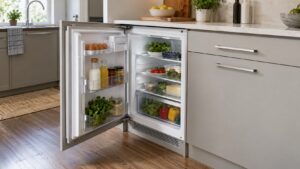
A built-in unit takes in air and exhausts it through a grille at the front, which is what allows it to sit flush between cabinets with no clearance at the back or sides. A freestanding unit vents at the rear and sides and needs open air around it.
Putting a freestanding unit into a cabinet opening is the most common installation error in this whole category. The appliance is not faulty; it is being asked to breathe through masonry. It runs constantly, never holds temperature and shortens its own life doing it.
Some models are rated for either, and those will say so. Our built-in against freestanding guide covers the distinction with the installation consequences.
Terms about the cabinet
ADA height describes a unit built lower so the counter above it meets accessibility height requirements. It matters outdoors mainly because it changes the cabinet opening.
Field reversible door means the hinge side can be swapped after purchase — worth checking in an outdoor kitchen where traffic flow around a grill decides which way a door should open.
Lock is more common outdoors than indoors, for obvious reasons, and is worth specifying before rather than after.
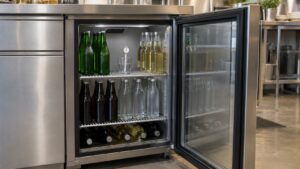
Solid against glass door is not only aesthetic outdoors. Glass admits light and loses more heat, and in direct sun that is a real load. Our outdoor collection buying guide covers how those choices interact.
Terms about the cooling
Condenser is where heat leaves the appliance — the part behind the front grille that has to stay clean. Evaporator is where cold is produced inside. Thermistor is the temperature sensor the control reads, and a drifting thermistor makes a mechanically perfect unit behave strangely.
Variable speed compressor describes a compressor that can run at part load rather than simply on or off, which gives steadier temperatures and quieter operation. Convection cooling refers to moving air through the cabinet with a fan rather than relying on air to circulate by itself.
Our convection cooling guide covers both of those in more depth.
Electrical vocabulary that is not optional outdoors
GFCI stands for ground fault circuit interrupter — an outlet or breaker that cuts power the instant current starts leaking to ground. Outdoor receptacles are required to be protected this way, and the reason is exactly what you would expect near water and metal.
It has a practical consequence people meet the hard way. A GFCI can trip on a compressor’s inrush current or on moisture in a connection, and when it trips, the appliance is dead until somebody presses reset. If your outdoor refrigerator or ice maker has “randomly stopped working” more than once, look at the outlet before you look at the appliance — and if it trips repeatedly, that is a fault being reported, not a nuisance to be worked around.
Dedicated circuit means the appliance has its breaker to itself. Outdoors this matters more than indoors, because the alternative is sharing with a grill light, a pump or a socket somebody plugs a pressure washer into.
Terms about water and ice
Outdoor ice production adds vocabulary of its own. A gravity drain relies on a fall from the unit to a drain point; a drain pump lifts the water where gravity is not available, and it is an extra component that needs occasional attention.
Water supply line outdoors has to be protected from freezing, which is the other half of winterizing. Our drain setup guide covers which arrangement suits which installation.
When to call
Call when an outdoor unit will not hold temperature with a clean condenser, when it runs continuously in moderate weather, when water is appearing where it should not, or when an appliance has been through a winter unprotected and is behaving strangely since.
We are an independent repair company and not a factory service arm. Pricing starts from a diagnostic visit and we confirm the estimate before any work begins. U-Line refrigerator repair covers controls, fans, sensors and sealed systems, and you can schedule a visit online.