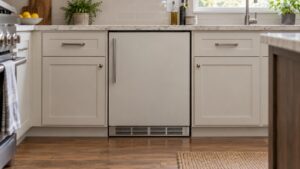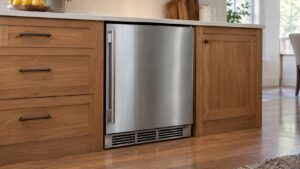
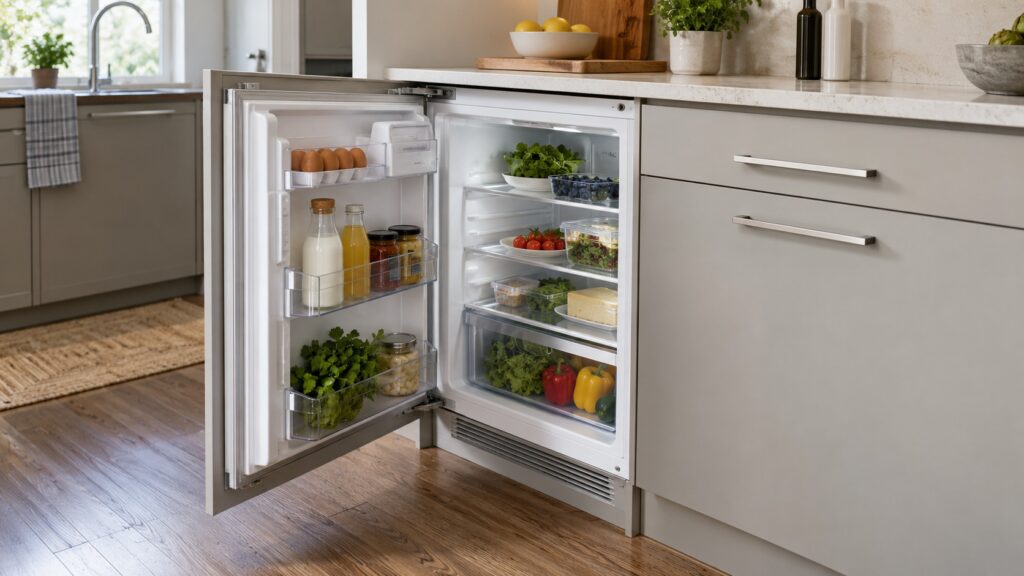
The U-Line field reversible door meaning is simple: the door swing can be changed to the opposite side by the person installing the unit, rather than only at the factory. Our model pages use the wording “field-reversible door” for the ACR014-SS01A ice maker and “reversible hinge” or “reversible soft-close door” on several refrigerators and wine coolers. This glossary explains that term and the hinge words around it, so that a spec sheet or a manual reads the way it was meant to. It does not replace the instructions for your model, which are the only authority on whether and how a door can be reversed.
What does field-reversible mean on a U-Line door?
“Field” is the installation site, as opposed to the factory. A field-reversible door can be moved from a left-hinged arrangement to a right-hinged one when the unit is installed, so the door opens toward the side your kitchen layout needs. Our pages list the feature on specific models, for example the ACR014-SS01A ice maker, and show similar wording such as “reversible hinge” on the UHRE518-SS01A refrigerator and UHWC124-SG31A wine cooler, and “reversible soft-close door” on the UHRE524-SG01A. Not every model has it. Our built-in freezer door reversal and leveling guide states the same caution: confirm that your specific model’s documentation allows field reversal before you start.
Which hinge and door-swing terms should you know?
Door swing describes where the door goes when it opens: the direction, and the clear space it needs in front of the cabinet. Hinge side is the edge of the door that is attached to the cabinet. People often say a unit is left-hinged or right-hinged, and the safest way to be sure you and a supplier mean the same thing is to describe it as “hinge on the left when you face the door.” Handing conventions can differ between catalogs, so read how your manual defines it before ordering anything. Hinge hardware is the upper and lower pieces that carry the door; on a reversible model these are the parts that move to the other side. Door gasket is the seal around the door edge, and it matters after a reversal because an uneven door will seal unevenly.
What do soft-close and articulating mean?
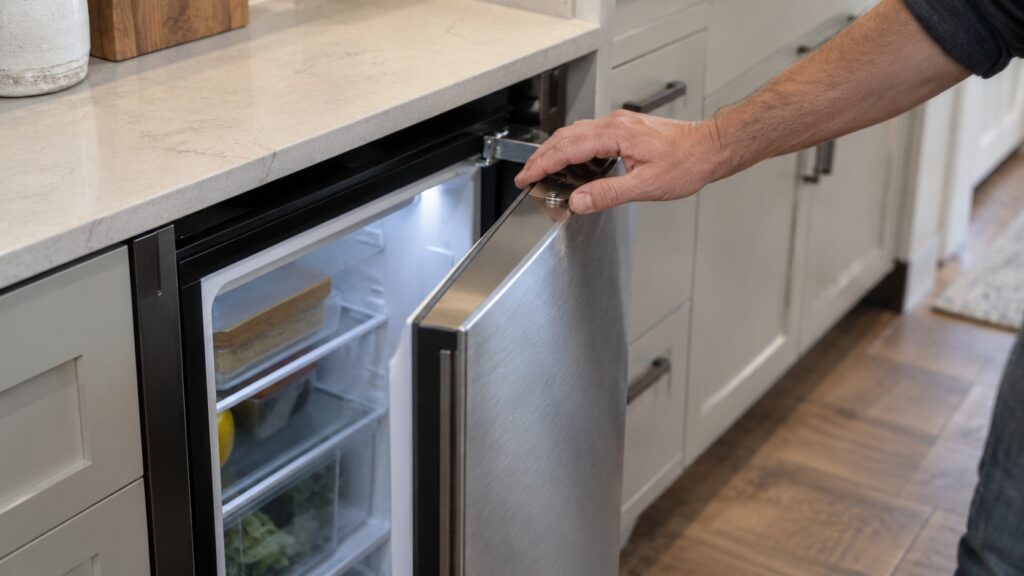
Our refrigeration and ice-making glossary defines soft-close as a door and hinge design that slows and cushions the door as it closes, preventing it from slamming. Our model pages also list a “soft-close articulating hinge” on the UHWC518-SG01A wine cooler. We read “articulating” in its ordinary sense, a hinge made of moving linkage rather than a simple fixed pin, but the manual for that model is the place to confirm how its hinge behaves, including how far the door opens against a neighboring cabinet. Soft-close hardware is one more reason to follow the manual closely when a door is reversed: the cushioned closing action should feel smooth again afterward.
How do panel-ready and overlay differ from stainless?
Our model pages describe finishes with their own words. A stainless model has a stainless door. An “integrated” or “panel-ready” model, such as the UHRF124-IS01A or the UHNP315-IS01A ice machine, is built to accept a cabinet-matching panel on the door. A “custom overlay frame,” listed for the U-3018WCOL-00B, is also a way of carrying a custom front. The practical point is that a panel adds its own weight and thickness to the door, so the supplier instructions for the panel and your model’s manual decide what can be attached and how the swing is affected. We do not give panel weights or dimensions, because they are model specific.
Why do clearance and level matter for any reversible door?
A reversed door opens into a different bay of your kitchen, so check what is on the new side before you commit: a wall, a neighboring cabinet, an island edge, a drawer. Our undercounter installation guide notes that an undersized opening can stop the door from opening fully, and that leveling affects how the door hangs against the gasket. After any reversal, the unit should still sit level front to back and side to side, the door should swing without rubbing, and the gasket should make even contact all the way around. If the door rubs, drops, or leaves a gap, stop and recheck the hinge mounting against the manual rather than forcing it closed.
When is a hinge problem a repair instead of a setup issue?
A door that sags, will not close by itself, makes a grinding sound, or no longer seals after it has been working well is a repair question, not a glossary question. A door that will not seal can lead to warm cabinet readings, frost and a unit that runs more than it should; our refrigerator door not sealing guide walks through the owner-level checks. For anything that involves removing a door while the unit holds food, plan the work so the cabinet is not left open longer than necessary, and call a technician if the hinge hardware is bent, cracked or stripped. See U-Line refrigerator repair for how a visit works.