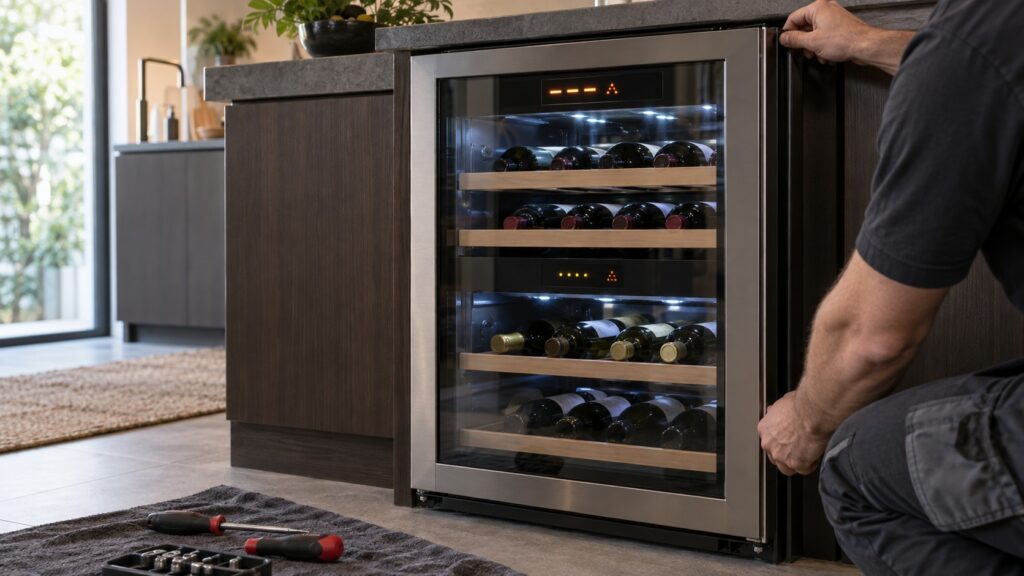
A U-Line E3 error code reports thermistor 3 open, E4 reports thermistor 4 open, and E7 and E8 report the same two sensors shorted instead. The numbers matter more than they look. Sensors 1 and 2 exist in every cabinet this brand builds; sensors 3 and 4 belong to cabinets that hold more than one temperature at once. The refrigerator code list on this site says so in as many words — its E3 entry reads third zone thermistor circuit open. If your wine fridge is showing E3 or E4, the fault is in the half of the cabinet that has its own set point.
What does the U-Line E3 error code mean on a wine fridge?
It means the board has lost contact with one of the sensors that governs a zone rather than the cabinet as a whole. A dual-zone wine fridge is not one cold box with a divider. Each zone has its own set point, its own reading and its own way of being fed cold air, and each needs a sensor the board can believe. Take one of those readings away and the board cannot regulate that zone, so it reports the sensor instead of pretending.
The electrical side of the failure is the same as it is lower down the code list, and we cover the mechanics of an open versus a shorted circuit in the guide to the E1, E2, E5 and E6 thermistor codes. What is different here is where the sensor lives and what stops working when it goes quiet.
Why do only some cabinets report E3, E4, E7 and E8?
Because a code only exists if there is something to attach it to. A 15-inch clear ice machine has one compartment, so its code list runs out after the second sensor. A wine fridge that stores reds above and whites below has two set points, and the count of sensors goes up with them. A cabinet with a convertible or third compartment adds another again, which is why the refrigerator list has an entry written in zone language while the wine fridge list is written in sensor numbers.
The practical use of that is diagnostic. If a code from this group appears on a cabinet you believed was single-zone, the model string is the thing to check first. Owners regularly inherit a dual-zone cabinet without knowing it, especially in a house bought with the appliances in place. The rating plate settles it in ten seconds.
What happens to the two zones while the code is showing?
Usually one zone behaves and the other does not, and the split is the clue. Bottles in the working half stay where they were set, while the half whose sensor has gone reads oddly, holds nothing steady, or simply stops receiving cold air. A board with no reading for a zone has no basis to open a damper or run a fan for it, so the safest thing it can do is leave that zone alone.
The result is easy to mistake for a cooling failure. If the two halves have drifted apart with no code on the display at all, the cause is more likely mechanical — read zones not holding separately, which covers the damper, door and loading side of the same complaint. A code changes the answer: with E3 or E4 up, nothing downstream is worth adjusting, because the part that decides has gone blind.
Why does the temperature look right when the code is up?
Because the display is showing you a set point or a last known value rather than a live measurement in that zone. This catches people out. A cabinet can read 55 degrees on the panel while the bottles in that half have been sitting several degrees warm for a week, and the only sign is a code the owner has learned to look past. Bottles do not go bad overnight, but a zone that has been running unregulated through a warm month is a real loss.
Treat a zone code as a reason to move anything valuable to the working half of the cabinet, or to another cabinet, until the sensor is back. Check the bottles by touch rather than by trusting the display, and keep the door closed while you decide — how dual-zone cooling works explains why a zone recovers slowly once warm air has been let in.
What can you do before a technician arrives?
Not much on the sensor itself, but three things genuinely help:
- Restart the cabinet once, at the breaker or the plug. Two minutes off is enough. If the code returns, it is live.
- Record which zone is misbehaving. Upper or lower, and by how much. That single observation tells a technician which end of the harness to open first and often saves a visit.
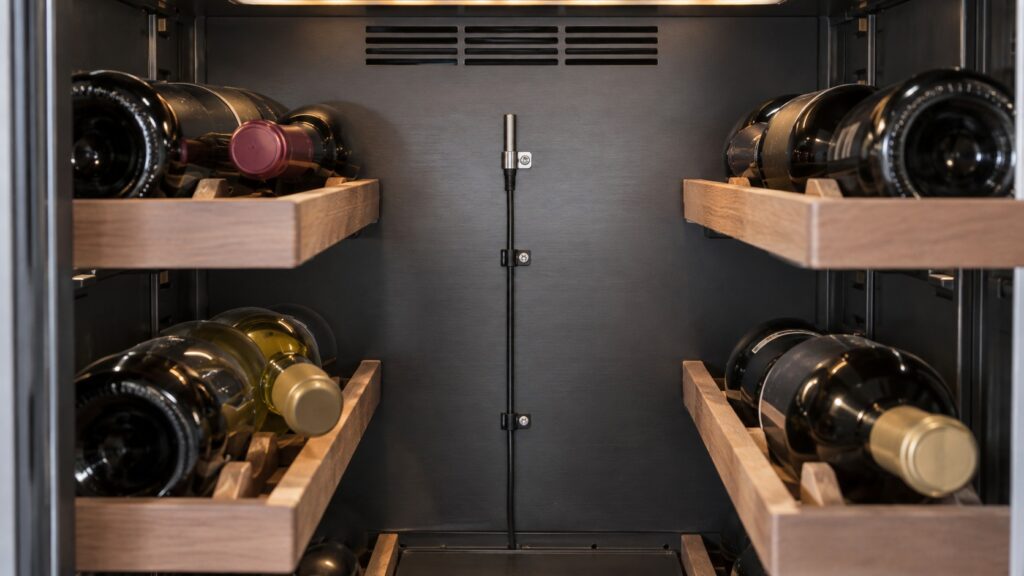
- Read the full model string off the plate. Sensor numbering follows the model, and a cabinet with two doors is wired differently from one with a single glass door and an internal divider.
Do not remove shelving or interior panels to hunt for the sensor. In a wine cabinet those panels also carry the lighting and the door heater circuit, and the sensor leads are thin. This is where the owner’s part of the job stops.
When does a zone code become a service call?
When it outlives a restart, which nearly all of them do. The choice between a sensor, the harness that reaches it and the board input is made with a meter, and on a dual-zone cabinet there is a fourth possibility worth ruling out: a sensor that is fine but has come loose from its mount and is reading the wrong air. That one looks like a cooling complaint and is found by eye, not by part swapping.
We are an independent repair company and not a factory service arm. Pricing starts from a diagnostic visit and we confirm the estimate before any work begins. Where a cabinet is old enough that the question is worth asking, we will say so rather than quote a sensor into a unit that needs more.
The code pages for E3 and E4 carry the short definitions, wine fridge repair is the service to ask for, and you can schedule a visit with the code and the model string to hand.