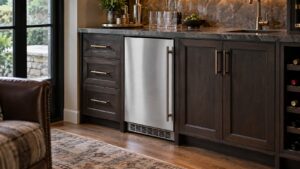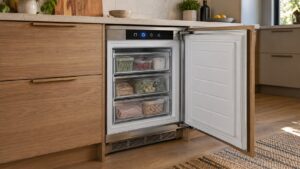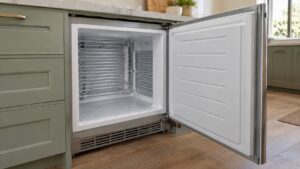
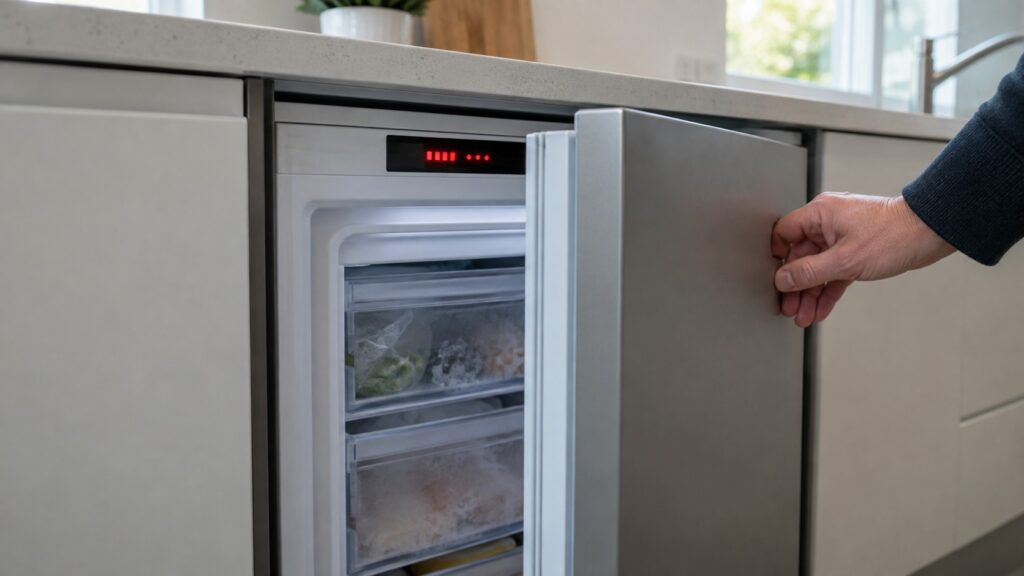
Three codes on this brand’s list describe the door, and they are not interchangeable. A U-Line E0 error code means door 1 open. E9 means door 2 open. 10E means the door is not sealing correctly. The first two come from a switch that watches whether a door is shut. The third comes from the cabinet noticing that it cannot hold temperature the way a sealed cabinet should. One is a question about a contact; the other is a question about a gasket. Knowing which you are reading saves an afternoon of pushing on a door that was already closed.
How does a U-Line freezer know its door is open?
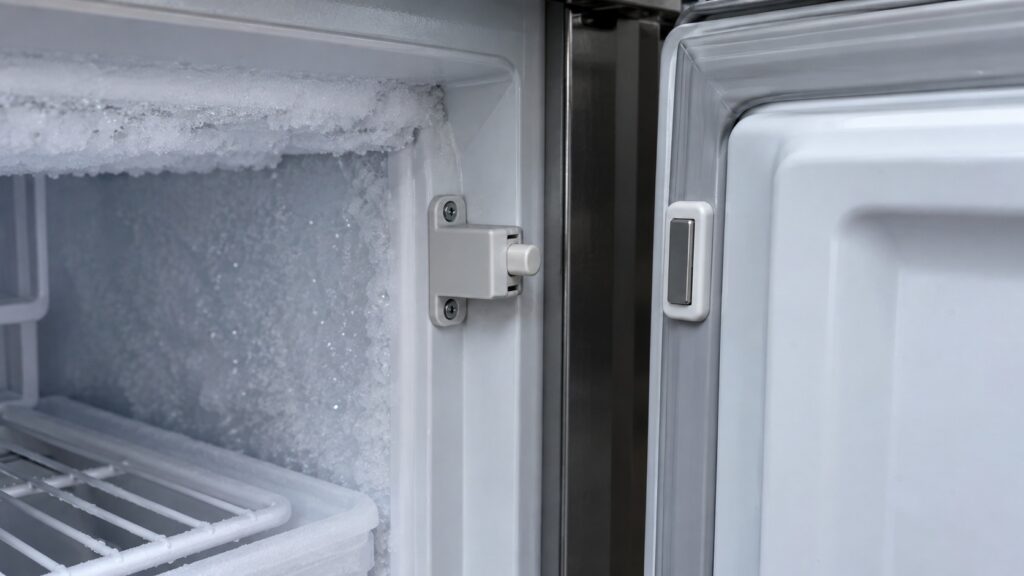
By a switch, not by looking. A magnet sits in the door and a matching sensor sits in the cabinet frame beside it. With the door shut the magnet holds the sensor in one state; as the door swings away the magnetic field weakens and the state flips. The board reads that flip as door open, turns the interior light on, starts counting for the door alarm and, on cabinets fitted with one, manages the heater that keeps condensation off the frame.
Two consequences fall out of that design. First, the cabinet does not know where the door is — it knows where the magnet is. Move the magnet, sag the hinge, or let the door drop a fraction on a heavy load of frozen food, and the switch reports an open door on a door that is visibly closed. Second, the switch itself is a small sealed component on a harness, so it can fail to the open state and produce E0 on a cabinet whose door has not moved at all.
Why does a single-door freezer report door 2?
It should not, and when it does the model string is the first thing to check. E9 exists for cabinets built with a second door or drawer, and on those units the numbering is fixed in the wiring rather than chosen by the cabinet. On a unit with one door, an E9 usually means the board is reading an input that has nothing plugged into it, which is a harness question and not a door question.
The reverse case is more common and more confusing. On a two-door cabinet, owners close the door they just used, see the code stay up, and assume the switch is broken. Half the time the other door is sitting a quarter inch proud on a full shelf. E0 and E9 are worth reading literally: they name which door, and the cabinet is rarely wrong about that.
What makes 10E different from an open-door code?
10E is not a switch report at all. The door seal code describes a cabinet whose door is shut according to its switch but which is behaving like a cabinet with a leak: recovery that takes too long, a compressor that runs far more than it should, frost appearing where warm moist air is being drawn in. The code is a conclusion, and it points at the gasket, the alignment of the door against the frame, and the way the cabinet itself is sitting in its opening.
On a built-in undercounter unit the last of those is the most frequently missed. A cabinet that was leveled into an opening years ago can be pushed out of square by a settling floor or a remodeled toe kick, and the door then meets the frame unevenly no matter how good the gasket is. Our guide to door reversal and leveling covers how the door is adjusted back to the frame, which is the fix for a surprising share of 10E codes.
What can you check without tools?
Door faults are the one part of this code list where an owner can genuinely narrow things down:
- Close the door slowly and watch the interior light. If the light goes out a good inch before the door touches the frame, or stays on until the last moment, the magnet and sensor are not lining up the way they did.
- Run a dollar bill around the seal. Close the door on it, then pull. The drag should feel the same at every point. Loose spots at the bottom corners are the classic 10E pattern.
- Empty the door shelves and try again. Weight in the door is what pulls a hinge down, and a freezer full of ice on the door is heavier than it feels.
- Check the cabinet is not being held open by its own contents. A bin pushed back an inch too far, or frost built up on a drawer runner, keeps a door off its seal without looking like it does.
- Wipe the gasket and the frame with warm water. Sugar and syrup spills glue a gasket down, and the gasket tears itself the next time the door is pulled.
Leave the switch and the heater circuit alone. The frame that carries them also carries wiring, and prying at a sensor to see if it moves is how a working switch becomes a replaced one.
Why does an open-door code matter beyond the alarm?
Because the cabinet reacts to the reading, not just reports it. Air that comes in while the door is open is warm and carries moisture, and moisture in a freezer becomes frost on the coldest surfaces it can find. A door that has been reported open for hours, or a seal that has been leaking for weeks, shows up later as heavy frost, longer run times and a defrost cycle that cannot keep up. That is the chain behind most calls where a door code and a frost complaint arrive together — see heavy frost buildup and defrost and drain care for what that does over a season.
When does a door code become a service call?
When the door is visibly closed, the seal passes the paper test, and the code stays. At that point the remaining candidates are the switch, its harness and the board input, and they are told apart with a meter. A 10E on a cabinet whose door has been adjusted and whose gasket is sound is the other case worth handing over, because the next step is squaring the unit in its opening rather than replacing anything.
We are an independent repair company and not a factory service arm. Pricing starts from a diagnostic visit and we confirm the estimate before any work begins. The E0 code page carries the short definition, freezer repair is the service to ask for, and you can schedule a visit with the code and the model string to hand.