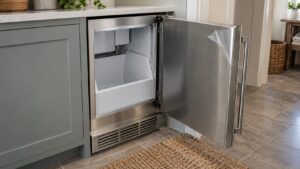
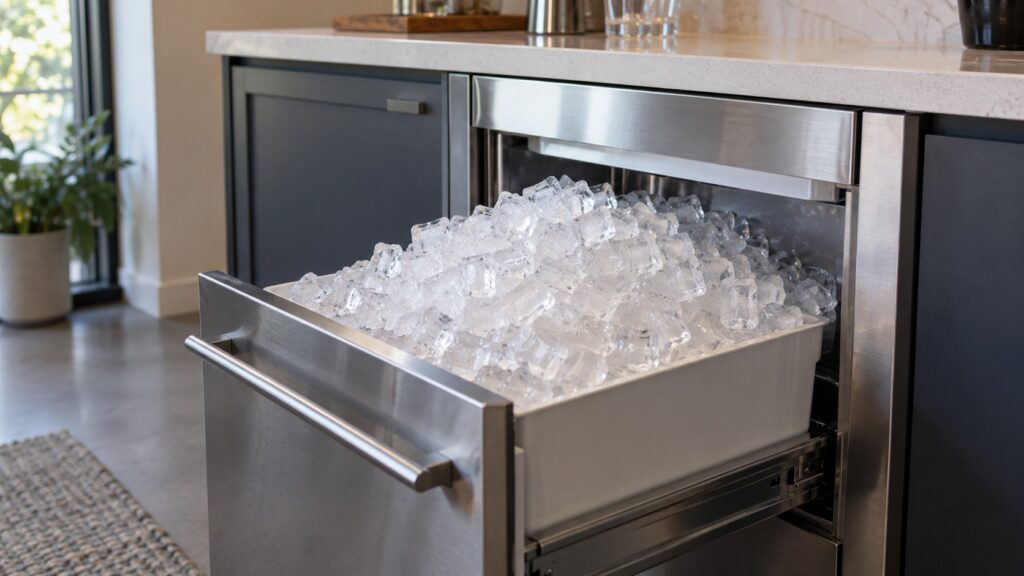
A U Line ice maker won’t stop making ice when the machine cannot tell the bin is full, or when it keeps making ice that melts again because the cabinet is warm. On the crescent machines our site covers, a bin arm tells the control board whether there is room for more ice, so an arm that is jammed, bent or blocked by a clump of fused cubes is the first suspect. A door that does not seal and a failed cabinet sensor are the next. Switch the machine off before you reach in, and do not force any part.
Why would a U-Line ice maker keep making ice?
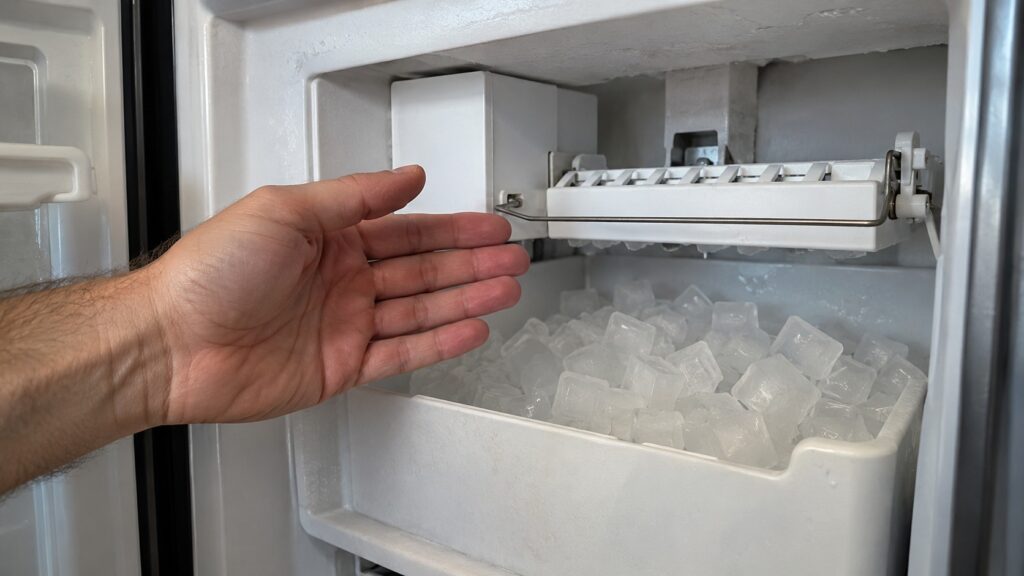
An ice maker is built to keep working until the bin is full, so the machine itself is not at fault just because it runs. The question is whether it knows when to stop. In the crescent ice machines described on our site, the bin control arm is a simple mechanical part with a large job: it tells the control board whether there is room for more ice. When the arm raises with the level of ice, production stops; when the arm cannot do its job, the signal is wrong. Our guide on a crescent ice machine bin arm stuck up describes the opposite failure, a stuck-up arm that stops ice production even when the bin is empty. Our pages do not describe an arm that fails to signal a full bin, but an arm that is jammed, bent or held by ice cannot do its job in either direction, and the physical checks are the same.
Before you start, remove the guesswork: is the bin truly overfull, or is ice melting and being replaced? Look at the ice. Fused, wet or slushy cubes at the bottom may point to melting and refreezing, which is a warm-cabinet problem. Dry, separate cubes piled above the rim may point to a bin-full signal that is not working.
How do you check the bin arm safely?
This is one of the more owner-friendly checks, but unplug the machine or switch off its breaker first, standing on a dry floor, because you are reaching into the ice compartment.
- Shut the water supply valve if water is running or the machine is overflowing.
- Scoop out the ice into a cooler or sink so you can see the arm and its pivot.
- Look for ice or frost around the arm’s pivot and resting position.
- Gently break away any clump that holds the arm in place. Do not bend the arm or force it.
- Move the arm through its full range by hand to see that it swings freely and does not bind on the hinge.
- Check that the bin is seated correctly; a bin that has shifted can interfere with the arm.
- Restore power and watch for a new cycle to start and stop normally.
If the arm is bent, cracked or loose at its mounting point, or if it moves freely and the machine still keeps producing, the arm’s internal switch or sensor may have failed. That kind of electrical fault is not something you can diagnose by eye.
Could a door that is not sealing be the real cause?
Yes. A machine that makes ice and then loses it makes much more ice than the household keeps. Our clean code guide says it directly: ice being made and melted rather than made and kept, and a bin that is warm because a door is not sealing will do exactly that. Look for frost or condensation around the door edge, a gasket that is torn or sticky, a door that sits slightly out of line and a bin that has shifted so the door cannot close fully.
Our ice maker door-open guide walks through the gasket, bin fit, leveling and the door switch, and the E0, E9 and 10E door codes page explains how the control judges the door and the seal. E0 is about whether the switch registers open, and 10E is about whether the door seals once closed. If either appears on the display, start there.
What if there is a code on the display?
Write it down. A cabinet temperature sensor fault can leave the board without the reading it needs to manage the cycle; our E1, E2, E5 and E6 thermistor codes guide says these codes mean the control asked a sensor for a reading and got an impossible answer. Our E1 pages list ice production that slows, stops or becomes inconsistent among the symptoms, and one of them also lists a unit running continuously without normal cycling, so what you see depends on the model. These are not owner repairs: do not open the cabinet looking for a sensor, because the harness runs beside mains wiring and the water circuit. Reseat nothing, and call for a diagnosis.
How do you stop it right now?
If ice is spilling or water is leaking, act in this order. Shut the water supply valve under the counter. Switch the machine off with its own control if it has one, or at its breaker from a dry floor. Take the ice out and wipe up the water. If water has reached the outlet or the cord, do not touch the plug; switch the breaker off first. Leave the machine off until you know the cause. The exact way to switch off differs by model, so check your owner’s manual, and our ice maker maintenance guide covers the routine habits that keep the bin, gasket and vents in order.
When should you call a technician?
Call if the arm is damaged, if it is free and the machine still will not stop, if a code returns after a power cycle, if the door switch is suspected, or if water is involved in any way beyond a closed valve. A technician can test the bin switch and the door switch with a meter and check the cabinet sensors, which is not a home job. You can read how a visit works on U-Line ice maker repair.