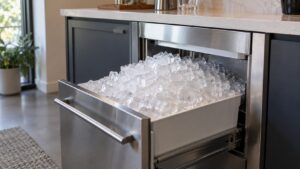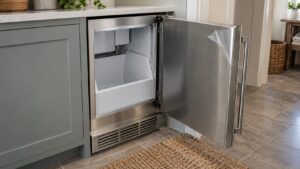

This U-Line nugget ice maker buying guide answers one question first: is nugget ice what you actually want? Nugget ice, which our pages also call pebble or chewable ice, is made of small, soft, porous pieces rather than hard cubes. A U-Line nugget machine makes it with a rotating auger and an extrusion head instead of a mold, and it keeps making ice until the storage bin signals that it is full. If you want that texture, the rest of the decision is about drain type, class, finish and where the machine will live.
What makes nugget ice different from other U-Line ice?
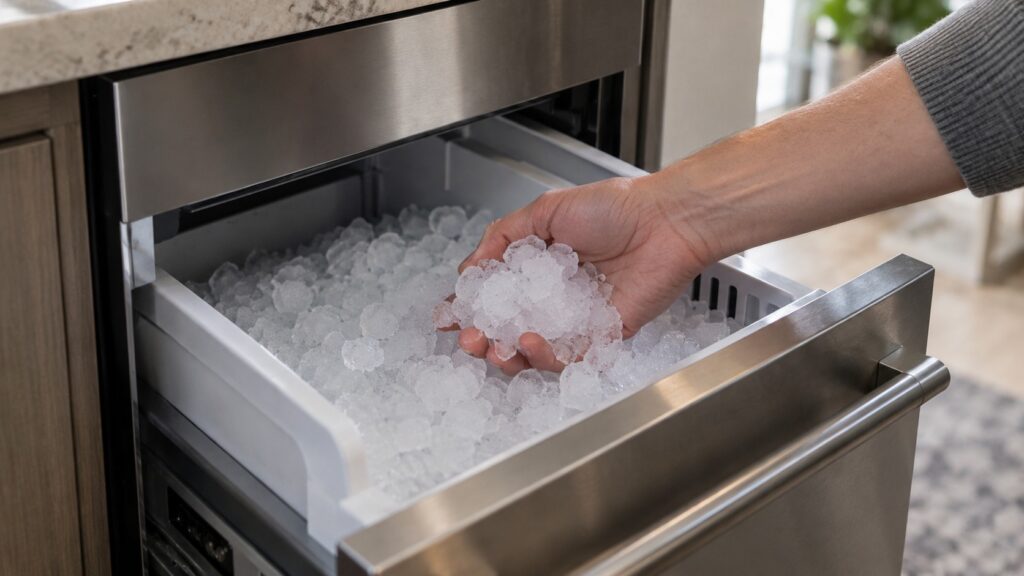
Our guide on how U-Line nugget ice machines work describes the process: water is fed into a cold vertical cylinder, an auger shaves and compresses the thin layer of ice that forms on the wall, and an extrusion head shapes the compacted ice into pieces. Because the ice is porous, it absorbs flavor from a drink and is easy to chew. A standard crescent machine works in separate freeze-and-harvest cycles, and a clear ice machine builds dense, transparent cubes for slow melt. Our clear, crescent and nugget comparison puts the three side by side. Nugget is the one to pick when the feel of the ice matters more than how it looks in a glass.
Which U-Line nugget model should you look at?
Our model pages list five nugget machines, all 15 inches wide. The UHNB115-SS01A is the 1 Class model without a pump. The UHNB315-IS01A and UHNP315-IS01A are 3 Class models rated up to about 90 lb/day, one without a pump and one with an integrated drain pump, and the UHNP315 is listed as panel-ready. The UONB115-SS01B is the outdoor version, listed at up to 90 lb/day with 30 lb of storage, and the UANB115-SS01A is the ADA version. Those figures come from our model pages. Daily output is a rated maximum, not a promise for every kitchen, so read the spec sheet for the exact model before you order.
We do not decode the letters in these model numbers, because our pages do not. If you want to see how U-Line numbers are organized, our model number guide covers what the site documents.
Do you need the version with a drain pump?
This is the practical split in the lineup. A machine without a pump depends on a drain line that slopes down to a drain point lower than the unit. A machine with a pump pushes water out and can reach a drain that gravity cannot. Our gravity drain versus drain pump guide explains the trade: a gravity setup has fewer parts to fail, while a pump setup gives you layout freedom and adds one more component to keep healthy, plus the sound of the pump running when it drains. Settle this before cabinetry is built, because changing it later means opening finished work. If you are unsure, ask a plumber or installer to look at the real location.
How do class, finish and location change the choice?
The 1 Class and 3 Class labels, the stainless or panel-ready finish, and the outdoor and ADA versions all change what you get at the counter, so decide where the machine will sit before you compare features. A built-in machine needs the ventilation clearance its manual specifies. An outdoor machine belongs in a protected outdoor kitchen setup; read our outdoor collection buying guide before you commit. An ADA model matters if reach height is a requirement in your project. The exact dimensions, rough-in sizes and clearances for each model are in its installation manual, not in this guide.
What should you expect to maintain?
Nugget machines run a continuous process, so they see more constant operation than a batch ice maker. In general, minerals in unfiltered water can build up inside a nugget machine, the condenser area should stay free of dust, and the auger motor, gearbox and extrusion head are moving parts that wear over time. Steady water flow and sensible filtration affect both output and ice texture. Plan for a routine cleaning habit; the steps are in our nugget machine cleaning and descaling guide, and the exact clean-cycle instructions for your model are in the owner’s manual. Everything that involves the auger housing or the water system beyond what the manual shows is technician work.
What questions should you ask before buying?
- Do I want soft, chewable ice, or dense slow-melt ice for cocktails?
- Where does the drain point sit compared with the machine’s outlet?
- Is this indoors, outdoors, or a project with an ADA requirement?
- Will filtered water be plumbed in, and how hard is my water?
- Do I have the ventilation clearance the manual asks for?
- Who will service it, and are they familiar with U-Line ice machines?
If the answers point to a nugget machine, the model choice usually falls out of the drain and location questions rather than from the ice itself, since all of our nugget models make the same style of ice. For a second opinion on a unit you already own, see our U-Line ice maker repair page.