
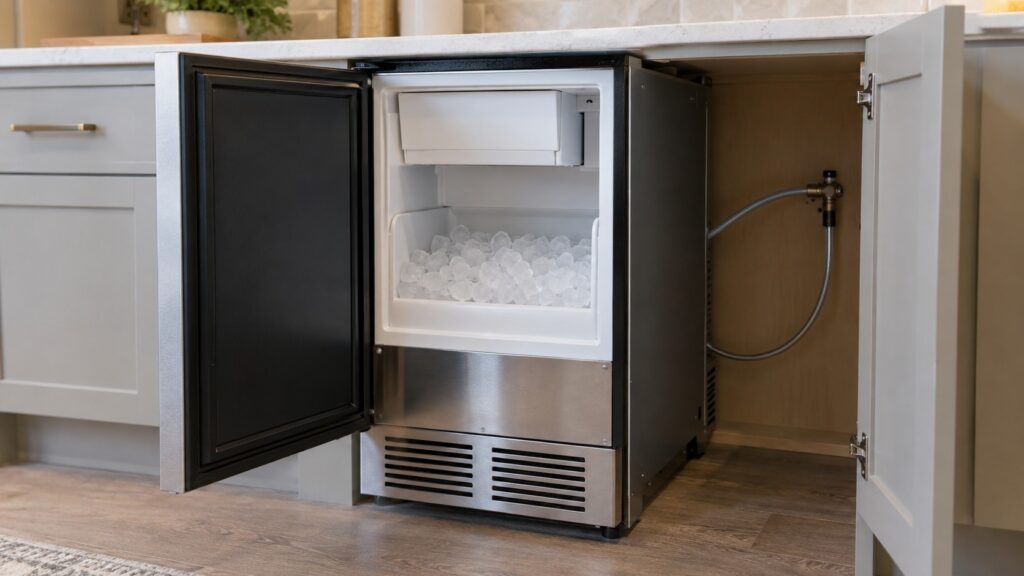
How a U-Line ice machine water inlet valve works comes down to one job: it is the gate between your household water line and the ice-making parts, and the control board decides when it opens. When the machine needs water for a cycle, the control sends a signal, the valve opens, water flows in, and the valve closes again when the fill is done. Our site describes the whole cycle in how a U-Line crescent ice maker works, but it does not describe the valve on its own, so this guide fills that gap in general terms. What the valve does on your exact model, and how it is mounted, is in the owner’s manual.
What does the water inlet valve actually do?
Think of it as an automatic faucet. In general, a water inlet valve on an appliance is a solenoid valve: it stays closed by default and opens only while it receives power from the control. That is why the machine can fill by itself and why a power or control fault can leave it filling too little or not at all. On a crescent machine, water is taken in for each ice-making cycle, so the valve is what meters that supply. On a clear ice machine, water circulates continuously over the chilled plate, and the supply still enters through a valve before it joins the circulating water.
Where does it sit in the ice-making cycle?
The cycle begins with a fill, then a freeze, then a harvest that releases the ice into the bin. The inlet valve matters at the first step. Without a proper fill, nothing freezes the way it should, and the symptoms downstream look like cold-side problems: small or hollow cubes, a thin ice layer, long recovery between batches. Our guides on hollow crescent cubes and slow ice recovery list water supply among the causes to look at, and the water supply problem guide covers the line itself.
What can go wrong with the valve or the water feeding it?
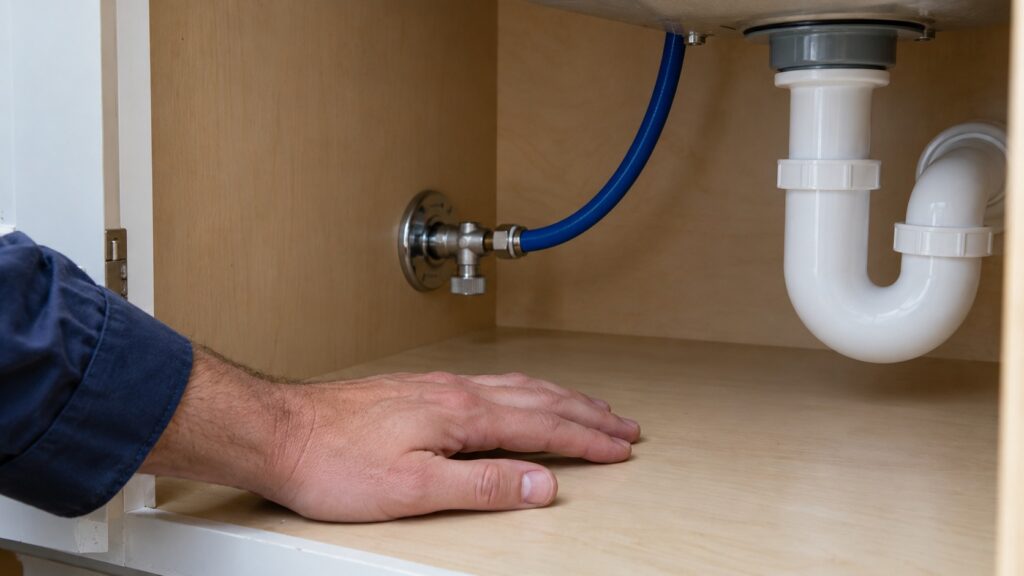
Most trouble that looks like a valve problem starts upstream. A supply shutoff that was closed during a remodel, a kinked line behind a cabinet, a clogged filter and low household water pressure all starve the valve of water, and our water supply turned off guide covers the simplest case. Mineral scale is another cause: our nugget pages say scale can build up in places a clean cycle does not reach, such as the water valve or pump. On the valve itself, the general failure modes are a coil that no longer opens it, a body that sticks partly open or closed, or a seat that leaks. We cannot tell you from outside which one you have, and we do not give figures for pressure or flow, because they belong to the model’s specifications.
What can an owner check safely?
- Confirm the household shutoff valve on the supply line is fully open.
- Look along the visible part of the supply tube for a kink, a crush or a drip.
- Check the water filter against the replacement schedule in your manual.
- Make sure other taps on the same line run normally, which suggests household pressure is fine.
- Check the machine is level and the door closes, since both can stop a cycle for other reasons.
- Read any code on the display against our thermistor code guide before assuming it is the valve.
Do not open the cabinet or remove a panel to reach the valve. It sits beside live wiring and the water circuit, which is a technician’s work. If you see water on the floor, do not step into standing water near the machine or any outlet. If water is anywhere near an outlet or the cord, switch the breaker off at the panel while standing on a dry floor, and never pull a plug from a wet outlet. Close the supply valve once that is safe.
Does the valve work differently on clear, crescent and nugget machines?
The role is the same, though the way the water is used differs. A crescent machine takes in water for each harvest cycle, a clear machine keeps water circulating over the plate and tops it up, and a nugget machine feeds a steady flow to the cold cylinder while the auger runs, which our nugget guide says makes it sensitive to water pressure and filtration. Because of that, a weak supply or a partly blocked valve shows up differently on each: thin or hollow cubes on one, cloudy ice on another, low nugget output on a third. That is why the guides for each symptom start with the supply and not with parts.
When is it time to call a technician?
Call when the supply is confirmed open and clean and the machine still fills poorly, when water keeps entering with the machine idle, when the machine hums without filling, or when there is a leak at the valve connection. A technician can test the valve and the control signal and tell you whether the part is the cause. Decisions about replacing the valve versus the machine are a separate question; our repair or replace guide for aging ice machines offers a framework, and U-Line ice maker repair shows how a visit works.