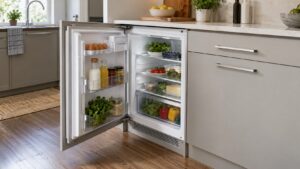
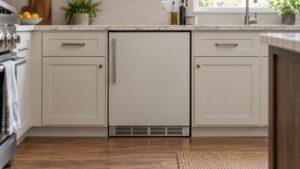
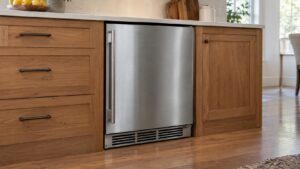
A U-Line refrigerator is a compact, built-in cooling appliance designed to fit flush into custom cabinetry rather than stand alone in a kitchen layout. Since 1962, the Milwaukee-based brand has built its reputation on undercounter and column-style refrigeration for kitchens, bars, and outdoor living spaces where a full-size refrigerator won’t fit or won’t match the cabinet run. This page is independent consumer information, not affiliated with U-Line, and is meant to help owners understand how these units work and what tends to go wrong with them.
About U-Line refrigerators
U-Line’s refrigeration lineup spans several tiers, from the entry 2000 Series to the Modular 3000 Series and the higher-end 3 Class and 5 Class platforms. Configurations include all-refrigerator undercounter drawers, single-door built-in refrigerators, and combination refrigerator-freezer units sized to slot beneath a counter or stack into a full-height column. Because these are built-in appliances, they rely on front-venting design so a cabinet can be closed on three sides without trapping heat, which places extra demands on the compressor and airflow system compared with a freestanding refrigerator.
Many of these refrigerators are installed well away from a traditional kitchen — in a home office, a media room, a finished basement bar, or an ADA-accessible kitchen where a lower-profile, front-venting cabinet makes more sense than a full-height appliance. That variety of installation contexts means two identical models can see very different operating conditions: one tucked into a well-ventilated island versus another built into a tight closet-style cabinet with minimal airflow. Understanding where and how the unit is installed is often the first step in diagnosing a performance issue, since many complaints that look like a compressor failure actually trace back to a ventilation-starved cabinet.
Signature features & technology
- Convection Cooling — a fan-driven airflow system that circulates cold air evenly around stored food to reduce temperature swings between the top and bottom of the cabinet
- Variable Speed Compressor — adjusts its speed to match the actual cooling load instead of cycling fully on and off, which reduces noise and helps maintain a steadier internal temperature
- Digital touch pad control with a cleaning indicator that alerts owners when the condenser needs attention
- Star-K certified Sabbath Mode on select models, which suspends automatic light and compressor cycling responses for religious observance
- Soft-close, articulating hinges that let the door swing wide for cabinet installation while closing gently on its own
- Factory-reversible door swing and panel-ready or stainless finishes for integration with surrounding cabinetry
Common problems
- Warm interior temperature caused by a condenser coil clogged with dust and kitchen grease, especially in enclosed cabinet installations with poor ventilation clearance
- Variable speed compressor running continuously without reaching set temperature, often tied to a failing start component, low refrigerant charge, or a blocked evaporator fan
- Digital control panel unresponsive or displaying an error code after a power surge or interruption
- Door gasket sagging or losing its seal, letting warm air infiltrate and causing frost buildup or a warm upper shelf
- Excessive compressor noise or vibration when the unit is not level or when door hinges bind under a heavy custom panel
- Condensation collecting on the cabinet face around the door frame, usually pointing to inadequate front-vent clearance or a failing door seal
Maintenance tips
- Vacuum or brush the front condenser grille every three to six months, more often in kitchens with heavy cooking grease or pet hair
- Confirm the cabinet opening meets the manufacturer’s clearance spec for front-venting airflow; a too-tight opening starves the compressor
- Check that the unit sits level using the adjustable feet, since an unlevel cabinet can strain the compressor and cause door drift
- Wipe the door gasket with mild soap and water and inspect it for cracking or flattening once or twice a year
- Respond promptly to the cleaning indicator light rather than letting dust accumulate on the condenser
- Keep the interior at least half stocked when possible, since thermal mass from stored food helps the compressor maintain temperature more efficiently
When to call a technician
Persistent warm temperatures after a thorough condenser cleaning, a compressor that runs constantly without ever satisfying the thermostat, unusual odors suggesting a refrigerant leak, or a control panel that won’t respond to a power reset all call for a qualified appliance repair technician. Sealed-system refrigerant work in particular requires EPA-certified handling and specialized tools that go beyond routine homeowner maintenance. A technician can also confirm whether an installation issue, such as insufficient front-vent clearance or an unlevel cabinet, is the true root cause before any parts are replaced, which can save an owner from paying for a repair that doesn’t address the underlying problem.
U-Line refrigerators are built and documented by the manufacturer in Milwaukee. For the latest product information, see the manufacturer at u-line.com.