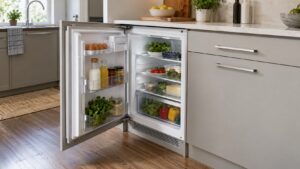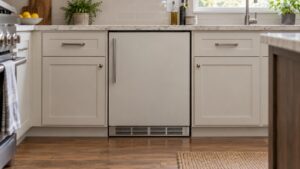
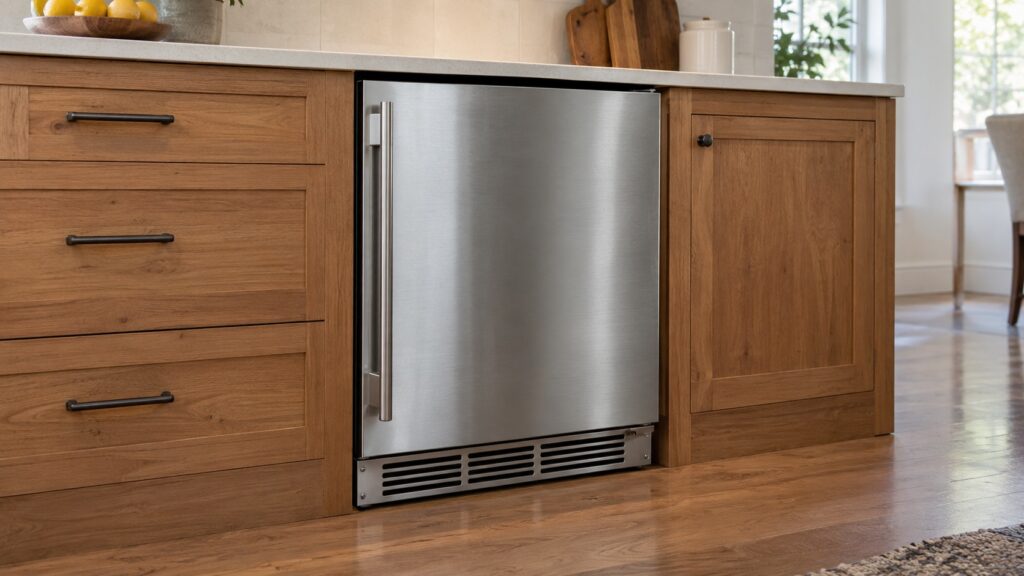
U-Line built-in ventilation works by pulling room air in through the front grille at the base of the cabinet, passing it over the condenser and compressor to carry heat away, and pushing the warmed air back out through the same grille. Nothing is vented to the back or the sides, which is exactly why a U-Line can sit flush between cabinets, and exactly why a blocked toe space, a layer of dust or a hot room can shorten its life.
How does a refrigerator get rid of heat?
A refrigerator does not make cold, it moves heat. The sealed system picks up heat from the inside of the cabinet and carries it to the condenser, a coil of tubing outside the cold space, where it is released into the surrounding air. The compressor, which drives the process, also gets warm as it works. If that heat cannot leave, the coil stays hot, the pressures rise and the compressor runs longer to do the same job, which is the road to early failure.
In a freestanding refrigerator the condenser sits at the back or underneath, and the cabinet breathes into the space around it. A built-in cabinet has no such space, so U-Line moved the whole air path to the front. Our guide on the convection cooling and variable-speed compressor describes the cold side of the same system.
Why does the air path run through the front?
Because the cabinet lives in a tight opening. An undercounter unit is installed between base cabinets, under a counter, with almost no clearance at the sides, the top or the back. There is nowhere for hot air to go except the front, where the room is open. The grille at the base is therefore the cabinet’s only intake and exhaust, and a small fan, on models that have one, keeps air moving across the coil. Because the cabinet draws and expels air at the same place, the grille must stay open and clear.
That design also explains why freestanding cabinets are a poor fit for a built-in opening. Putting a unit that vents to the sides and back into a tight cabinet space makes it breathe its own hot air, and it runs constantly. Our built-in versus freestanding guide explains how to tell which type you have.
What happens when the toe space is blocked?
When the grille is closed off, the cabinet recirculates the same warm air. The condenser temperature climbs, and the compressor runs almost all the time to compensate. You notice this as a unit that never seems to cycle off, a grille that feels hot instead of mildly warm, and a cabinet that cannot hold its set temperature on a warm afternoon. Left alone, the compressor overheats and either trips its internal protector or fails outright, a repair far larger than the problem that caused it.
Common causes are a solid kick plate added during a remodel, cleaning supplies stored in the toe space, a rug or a mat pushed against the grille and, most often, a layer of dust and pet hair that has built up over the years. The fix is cheap: clear the space and clean the coil.
How does dust affect the system?
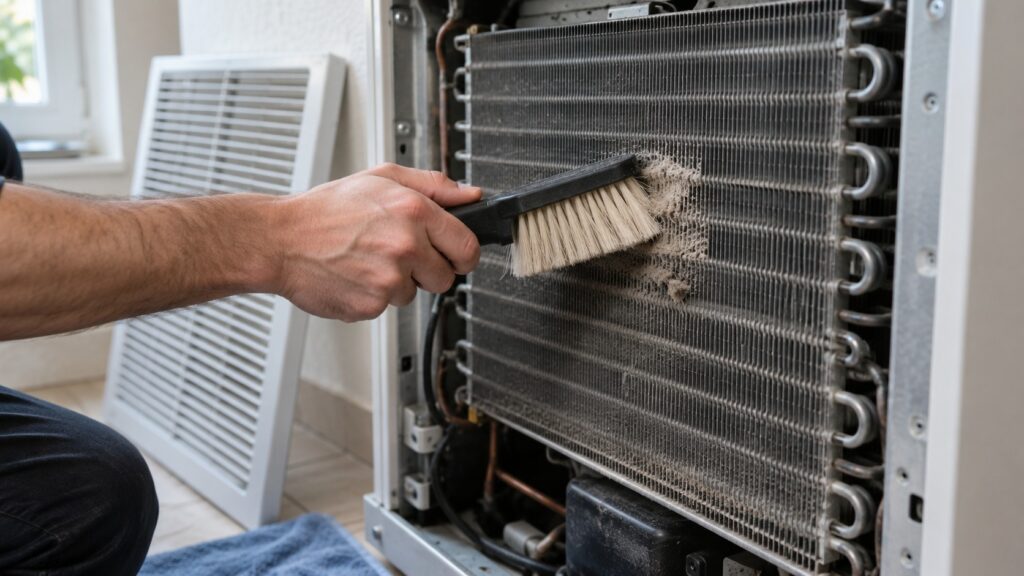
Dust acts as insulation. A thin mat of lint and hair over the condenser fins slows the transfer of heat into the air, so the same fins now need a hotter coil to release the same heat. The effect arrives slowly, a few percent of efficiency a year, so most owners never connect the cabinet running harder to the dust. Our guide to a U-Line refrigerator condenser that needs cleaning lists the signs, and the wine cooler version is covered in our wine cooler condenser guide.
To clean it safely, switch the cabinet off at the wall, remove the front grille as the manual describes, and use a soft brush and a vacuum with a brush attachment. Never bend the fins, use compressed air at close range or push a brush deep into the cabinet, since the coil is delicate and the tubing carries refrigerant. Do this twice a year, or every few months if you have pets.
How does room temperature change the picture?
The warmer the room, the harder the cabinet works, because it has less of a temperature difference to release heat into. An undercounter unit in a hot kitchen, beside a dishwasher or an oven, runs more than one in a cool room. Outdoor cabinets are built for a wider range, but they too suffer in direct sun or in a closed-in enclosure with no airflow. If a cabinet struggles only on the hottest days, the room and the airflow are the first suspects, not the sealed system. Our outdoor installation guide shows how an enclosure should breathe.
When is it time for service?
Call if the cabinet runs nonstop after you have cleared and cleaned the grille, if the grille is too hot to rest your hand on, if the compressor trips on and off, or if the cabinet cannot reach its set temperature in a normal room. A technician can check the condenser fan, the airflow and the compressor. See our refrigerator repair service for what a visit covers.