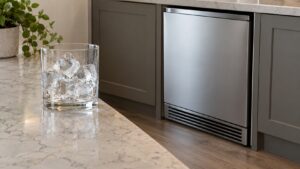
This guide covers U-Line Ice Machine Drain Setup with practical, technician-backed advice.
Getting the drain configuration right on a U-Line ice machine matters just as much as the water supply connection, since a poorly planned drain is one of the more common sources of leaks and standing water in built-in installations. U-Line ice machines can generally be installed with either a gravity drain or a drain pump, and which one makes sense depends largely on where the unit sits relative to the home’s plumbing.
Understanding the U-Line Ice Machine Drain Setup
Below, our specialists break down everything you need to know about the U-Line Ice Machine Drain Setup.
How a gravity drain works
A gravity drain relies on a downward-sloped line running from the unit to a drain point below it, using nothing but the pull of gravity to move water away from the machine. This is the simpler of the two setups mechanically, since there’s no pump or motor involved, which also means there’s one less component that can fail over time. The tradeoff is that gravity drains require the drain point to be lower than the unit’s outlet with enough consistent slope along the entire run, which isn’t always possible depending on where the ice machine sits in relation to existing plumbing.
How a drain pump setup works
A drain pump setup uses a small pump to actively push water out of the unit and up or across to a suitable drain point, which makes it the practical choice when the ice machine is installed in a location where gravity alone can’t get water to a drain — a common scenario for under-counter installations far from existing plumbing runs. This flexibility comes with an added component to maintain: the pump itself, along with its own electrical connection, needs to be functioning correctly for the drain to work at all.
Choosing between the two
- Proximity to existing drain lines — a gravity drain is generally simpler and has less to maintain if the installation location already sits near a drain with adequate slope.
- Cabinet layout and location — a drain pump is often necessary for installations in kitchen islands or locations without a nearby low-point drain.
- Long-term maintenance — a gravity drain has fewer moving parts to service, while a drain pump adds one more component to check periodically for proper operation.
- Noise considerations — a drain pump introduces brief operating noise during each drain cycle, which is worth factoring in for installations near living or entertaining spaces.
Installation considerations regardless of drain type
Whichever drain configuration is used, the line itself should be free of tight bends or kinks that could restrict flow, and it should be secured so it can’t shift out of position over time. It’s also worth confirming that whatever drain point the line feeds into — whether a floor drain, standpipe, or connection to household plumbing — is appropriate for continuous or intermittent ice machine discharge according to local plumbing code. Getting professional input at the planning stage, particularly for drain pump installations that involve an electrical connection, helps avoid the kind of drainage backup or leak that’s much harder to trace once cabinetry and flooring are already in place around the unit.
Maintaining the drain over time
Regardless of which setup is used, periodically checking that the drain line hasn’t become kinked, disconnected, or blocked by mineral buildup helps prevent the kind of slow leak or backup that can go unnoticed under a built-in installation until it’s caused real damage. If water ever appears around the unit despite a properly sloped gravity line or a functioning pump, that’s a sign worth investigating promptly rather than assuming it will resolve on its own.
Planning the installation before the cabinetry is finished
Drain configuration is one of the details that’s far easier to get right before surrounding cabinetry is built out than to change afterward, which is why it’s worth settling on gravity drain versus drain pump early in a kitchen or bar remodel rather than treating it as an afterthought once the unit is ready to install. Retrofitting a drain pump into an installation that was only ever plumbed for gravity, or vice versa, often means opening up finished cabinetry that would otherwise stay untouched, so a little extra planning at the design stage avoids that entirely.
If you’re unsure which setup fits your kitchen layout, it’s worth having a plumber or installer look at the actual location relative to existing drain lines before committing to cabinetry design around the unit. This is especially true for island installations, bar setups away from the kitchen’s main plumbing, or any location where the distance to the nearest drain isn’t obvious from a quick look. Getting this decision right at the planning stage is one of the simplest ways to avoid drainage problems for the life of the unit.
U-Line clear ice machines are built and documented by the manufacturer in Milwaukee. Manufacturer specifications and use-and-care guides are published at u-line.com.