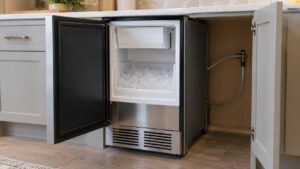

These U-Line crescent ice machine summer tips focus on the habits that matter most when demand for ice spikes and ambient kitchen or bar temperatures climb at the same time — the two conditions that push a crescent ice machine hardest. A crescent machine that runs fine all winter can start falling behind on output or producing smaller cubes in summer simply because it is working against a warmer room and a thirstier household at once, and a few habit changes ahead of the season prevent most of the complaints that would otherwise show up as a service call in July, when technicians are also busiest and appointments are hardest to get quickly.
Why does summer hit a crescent ice machine harder than other seasons?
A crescent ice machine’s compressor and condenser work against the surrounding air temperature to remove heat from the water as it freezes, so a warmer room in summer means the same compressor has to work harder for the same output. At the same time, household or bar demand for ice typically rises in summer, which means the unit is being asked to produce more while working under worse conditions. Neither factor alone is usually enough to cause a real problem, but the two together are why output complaints cluster in the warmer months even on units that ran perfectly fine all winter.
None of this means summer use is somehow risky for the machine — crescent ice machines are designed to handle a range of ambient conditions and demand levels. The tips here are about keeping output steady and predictable during the season when the margin for error is smallest, not about preventing damage to a machine that is otherwise working as intended.

What can you actually do about the room temperature?
If the unit is installed somewhere that gets noticeably warmer in summer — near a window, close to an outdoor-facing wall, or in a room without air conditioning — even a small improvement helps: closing a blind during peak afternoon sun, running a room fan to keep air moving around the unit, or simply making sure nothing has been stacked in front of the ventilation grille since last season. None of these require touching the machine itself, and together they can meaningfully reduce how hard the compressor has to work during the hottest part of the day.
How should usage habits change during high-demand periods?
The biggest mistake during a hot stretch or an entertaining season is letting the bin fill completely and then drawing it down all at once for a single event, which asks the machine to recover a full bin’s worth of production right when demand is highest. Drawing the bin down gradually and more often during a known busy period keeps the machine cycling steadily rather than swinging between a full bin and an empty one, and it means you are less likely to run short right when you need ice most.
This habit also protects the machine itself over the course of a season, not just your ice supply on any given day. Repeatedly forcing a full recovery cycle from empty asks more of the compressor and water system in a short burst than steady, spread-out cycling does. Over a whole summer of entertaining, a machine run this way tends to show wear-related issues sooner than one that was drawn down more evenly, even though both machines produced roughly the same total amount of ice. Spreading demand out is simply gentler on the same hardware than concentrating it into a handful of full-recovery cycles across the season.
Does travel between properties change how you should prepare the machine?
If the crescent ice machine sits at a seasonal or secondary property that goes unused for stretches at a time, arriving for a busy weekend and expecting full output immediately is one of the more common summer disappointments. A machine that has been idle for weeks needs time to run through its normal cycle a few times before output reaches its usual pace, and any ice made during that first hour or two is worth discarding rather than trusting, since it may carry stale odors picked up while the machine sat unused. Arriving a day ahead of guests, rather than the same afternoon, gives the machine time to catch up before it actually needs to perform.
What water-supply checks are worth doing before a busy season?
Low water pressure or an aging filter both reduce ice output, and both are easy to check ahead of time rather than discovering them mid-event. Confirming the water line has full pressure, and replacing the filter if it is due or close to due, before a known busy stretch — a holiday weekend, a planned gathering — avoids finding out the hard way that output has quietly declined over the preceding weeks.
If you are hosting a specific large event rather than dealing with steady summer-long demand, it is worth running the machine at full capacity for a day or two beforehand rather than assuming it will simply keep up on the day itself. This gives you time to notice a lagging output before guests arrive, when there is still time to supplement with bagged ice if needed, rather than discovering a shortfall mid-event with no good options left.
What summer habits actually make the biggest difference?
- Improve airflow around the unit if the install location gets warmer in summer than in winter.
- Draw the bin down gradually during high-demand stretches instead of letting it fill and then emptying it all at once.
- Check water pressure and filter condition ahead of a known busy period, not after output has already dropped.
- Clean the bin more frequently when turnover is faster, since more cycles mean more opportunities for residue to build up if it is skipped.
If output still lags after adjusting these habits, our crescent ice machine routine maintenance guide covers the deeper seasonal service, and our low ice production guide is the place to start troubleshooting a genuine drop in output. For water quality specifically, see our tips for clear, odor-free ice. You can schedule a visit if a busy season is approaching and you want the unit checked ahead of time.