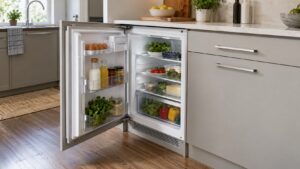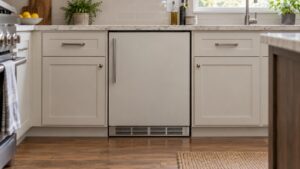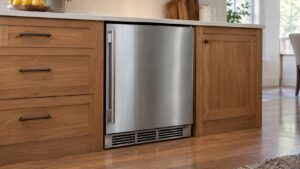
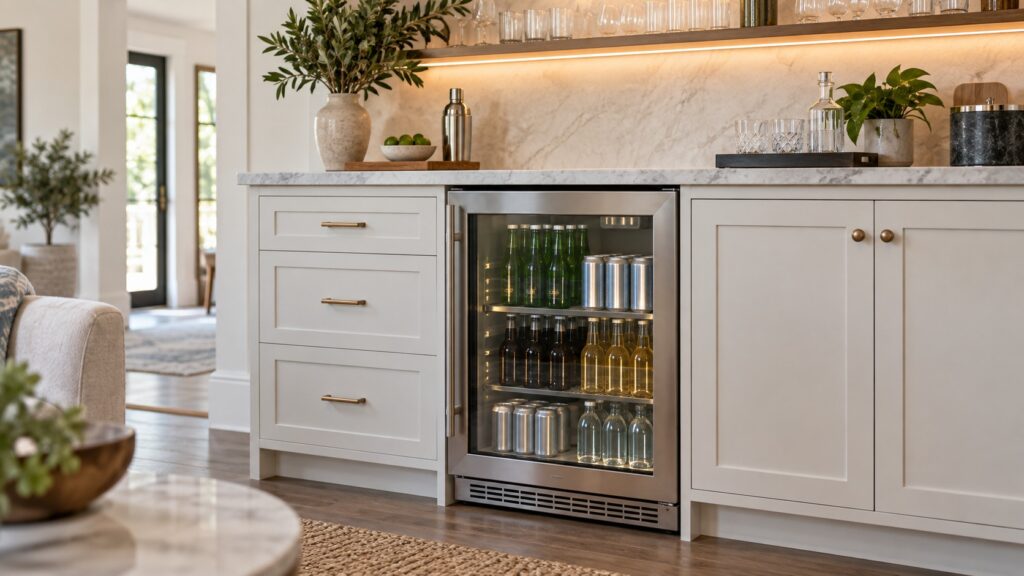
An undercounter beverage center is asked to do something a kitchen refrigerator never is: hold temperature in a sealed cabinet opening, often in a room that is warmer than a kitchen, with a glass door and a condenser that breathes through a grille a few inches tall. When a u-line beverage center warm complaint arrives, the cause is far more often the installation or the grille than the sealed system.
Start with the grille, always
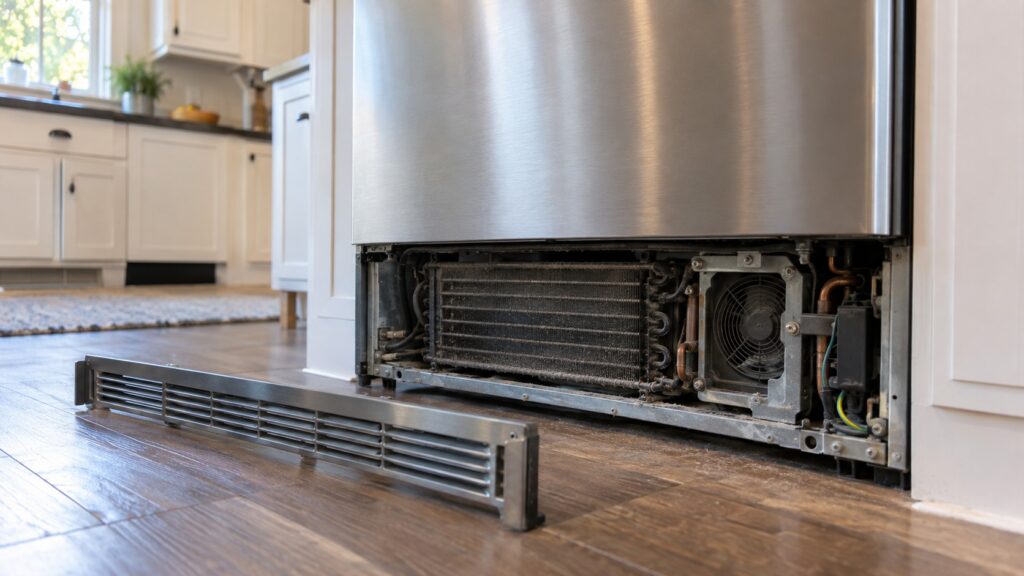
A built-in unit rejects all of its heat through the grille at the base of the door. Air is drawn in at one side, passes over the condenser, and is pushed out at the other. That path is a few inches tall and it is at floor level, which means it collects dust, pet hair and whatever gets swept toward it.
Pull the grille — most lift or unclip — and look at the condenser behind it. A gray felt across the fins is the most common cause of a cabinet that has slowly stopped holding temperature. Vacuum it with a brush attachment, then a soft brush along the fins, and be careful not to bend them.
Check nothing is parked in front of the grille either. A bar stool, a bin or a rug pushed against it defeats the whole arrangement. Our condenser cleaning guide covers the job in detail.
Ambient temperature is part of the specification
These cabinets are rated to work within a range of room temperatures, and they are frequently installed in exactly the places that exceed it — a garage bar, a sunroom, an outdoor kitchen, a basement that runs hot because the furnace is in it.
Above the rated ambient, the unit runs continuously and still falls behind. That is not a fault, and no amount of turning the setting down fixes it, because the limit is on the heat it can reject rather than on the cold it can make. If the room is hot and the unit is indoor-rated, the answer is either to cool the room or to fit a model rated for the location.
The seasonal version of this is worth watching for: a cabinet that is fine in March and struggles in July has an ambient problem, not a component problem.
The door, which does more work than you think
Glass doors lose more heat than solid ones and they are heavier, which means hinges settle over time and the door stops closing squarely. Test the seal by closing the door on a banknote and pulling at several points around the edge. It should grip everywhere.
Look at the gasket itself for flattened sections, splits at the corners, and residue holding it away from the frame. A gasket that has gone hard in a warm room can often be improved by warming it gently and reseating it. Our door sealing guide covers what is recoverable and what is not.
Also check the door is not being held fractionally open by a shelf, a tall bottle or a full bin inside. It takes very little to keep the latch from pulling in.
Loading, and the vent people cover
Cold air is produced at an evaporator and distributed by a fan. On most undercounter cabinets the outlet is on the rear wall or high at the back, and a row of bottles laid flat against it blocks the airflow the whole design depends on.
Leave a finger’s width of clearance behind the rearmost items and do not fill the cabinet to the point where nothing can move. A reasonably full cabinet actually holds temperature better than an empty one, because the contents carry thermal mass — but packed is not the same as full.
How to measure it properly
Put a thermometer in a glass of water on a middle shelf and read it after several hours, ideally overnight. That reads the temperature the contents actually experience. The display reports one sensor at one point and is smoothed, so it will not show you the swing.
Read it twice — morning and evening — and note whether the difference is small or large. A steady reading a few degrees above the setting points at capacity: the unit is doing its best against heat it cannot reject. A wildly swinging reading points at the door, the loading or a fan.
What is left after all that
If the grille is clear, the condenser clean, the room within range, the door sealing and the vents unobstructed, then the remaining candidates are real faults: a condenser or evaporator fan that has stopped, a thermistor reporting the wrong temperature, a control board, or a sealed system that has lost refrigerant.
The useful clue between them is what the compressor is doing. Running constantly with clean coils points at the sealed system or at a fan. Not running at all points at the control, the thermistor or the compressor’s start components. Our cabinet not cold enough guide works through that split.
A thermistor fault is worth knowing about because the cabinet behaves oddly while every mechanical part is fine — the control is acting faithfully on a wrong number.
When to call
Call when the cabinet will not hold temperature with a clean condenser, a sealing door and an in-range room; when the compressor runs without stopping; when you can hear no fan at all; or when the unit is icing internally.
We are an independent repair company and not a factory service arm. Pricing starts from a diagnostic visit and we confirm the estimate before any work begins. U-Line refrigerator repair covers fans, thermistors, controls and sealed systems, and you can schedule a visit online.