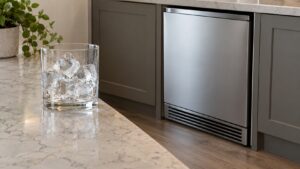

An ice bridge — where individual cubes fuse together into a solid sheet instead of separating cleanly during harvest — is a specific problem tied to how U-Line’s Clear Ice Technology freezes water in stages on a chilled plate. Because the process depends on precise timing between the freeze and harvest phases, a bridge usually points to something interrupting that rhythm rather than a random malfunction. Here’s how to work through it.
Likely causes of an ice bridge in a U-Line clear ice machine
- Harvest cycle timing drift — clear ice forms by freezing water in thin layers over multiple passes; if the harvest doesn’t trigger at the right point, cubes that should separate stay connected at their base.
- Overfilled reservoir or incorrect water level — too much water on the freezing plate at once encourages adjacent cubes to grow into each other before the cycle ends.
- Mineral buildup on the plate or grid — scale from hard water changes how evenly the plate releases heat, which can throw off the separation between cube cavities.
- Ambient temperature swings — a warm kitchen or poor ventilation around the unit can slow the freeze phase just enough that cubes bridge before the harvest cycle kicks in.
- Water quality or mineral content — the same minerals that give clear ice its purity can, in higher concentrations, affect how cleanly cubes release from one another.
- Sensor or control failure — the board relies on temperature sensors to know when to transition from freeze to harvest, and a sensor reading slightly off can shift that timing enough to cause bridging.
What you can check yourself
- Unplug the ice machine before opening it to inspect the plate, reservoir, or grid.
- Look at the ice grid and freezing plate for visible scale or cloudy mineral deposits, and clean them per the owner’s manual using a cleaner rated for ice machines.
- Confirm the water fill level matches what the manual specifies, since even a slightly high fill can be enough to cause bridging.
- Check that the room around the unit isn’t unusually warm and that the grille has clear airflow, since heat buildup nearby can slow the freeze phase.
- Run the built-in cleaning cycle if the touch pad’s cleaning indicator is lit, since scale is one of the more common and fixable causes of bridging.
- After cleaning, run one or two full cycles and check whether the bridging pattern improves or stays the same before deciding next steps.
- Watch the display for any E-series error code, since a code appearing alongside the bridging points toward a sensor or control issue rather than water chemistry.
When to call a technician
If cleaning the plate and confirming water level don’t resolve the bridging, the likely cause has moved to sensor calibration or harvest cycle timing controlled by the board, and that’s not something to open up on your own. A technician can test the freeze and harvest sensors against known values, inspect the water valve for consistent fill volume, and confirm the control board is triggering harvest at the correct point in the cycle. Because clear ice production depends on tightly timed stages, persistent bridging after basic cleaning is a good reason to schedule a service visit rather than keep adjusting water levels by trial and error.
Why cleaning cadence matters more for clear ice machines
Because clear ice depends on precisely timed layers building up on a chilled plate, even a modest amount of scale can throw off how evenly heat transfers across the freezing surface. This is different from a conventional ice maker, where a similar amount of scale might just slightly change cube size without causing a visible defect like bridging. Owners coming from a standard ice maker sometimes underestimate how much cleaning frequency matters for a clear ice machine specifically, and sticking to the cleaning interval in the owner’s manual — rather than cleaning only when a problem appears — tends to prevent bridging from becoming a recurring issue in the first place.
Water hardness in your area is also worth knowing generally, since households on notably hard water may need to clean more often than the standard interval to keep the plate and grid free of the scale that contributes to bridging. If bridging has become a repeat issue even with regular cleaning, that repetition itself is useful diagnostic information, since it shifts the likely cause away from a one-time scale buildup and toward the timing or sensor issues that call for a technician’s evaluation.
U-Line clear ice machines are built and documented by the manufacturer in Milwaukee. For the latest product information, see the manufacturer at u-line.com.