Deciding whether to repair or replace a U-Line built-in refrigerator is rarely a simple calculation, especially since built-in units are integrated into surrounding cabinetry in a way that makes replacement more involved than swapping out a standalone appliance. Rather than defaulting to either option, it helps to weigh a few concrete factors — the age of the unit, which component has failed, and how often it’s needed repairs — before deciding which direction makes more sense.
Understanding the U-Line Built-In Refrigerator
Below, our specialists break down everything you need to know about the U-Line Built-In Refrigerator.
Consider the age of the unit
Refrigeration appliances generally have an expected service life, and where a U-Line built-in refrigerator falls within that range matters more than any single symptom. A unit early in its expected lifespan that develops an isolated problem is usually worth repairing, since most of its useful life is still ahead of it. A unit well past the upper end of typical refrigerator longevity that needs a significant repair is a different situation — even a successful repair may only buy a limited amount of additional time before another component reaches the same age-related wear point.
Consider which component has failed
Not all repairs carry the same weight. Simple, self-contained fixes — a gasket, a door switch, a control board, an interior fan — are generally straightforward and don’t reflect on the overall health of the unit. Sealed-system issues (refrigerant leaks, compressor failure) are more significant, both because they’re more involved to repair and because a compressor failure on an older unit can be a signal that the system as a whole is nearing the end of its service life. When a sealed-system repair is on the table, it’s worth asking a technician directly how that repair compares, in scope and expected outcome, to simply replacing the unit — especially for a built-in refrigerator where removal and reinstallation add complexity either way.
Consider repair history and pattern
A single repair on an otherwise reliable unit is a very different situation than a unit that has needed service multiple times in a short period. If a refrigerator has already had one or two repairs and is now showing a new, unrelated problem, that pattern suggests general wear across multiple systems rather than an isolated issue, which tips the calculation further toward replacement. On the other hand, a first-ever repair on a unit that has otherwise run reliably for years is a reasonable candidate for fixing rather than replacing.
Factor in the built-in installation itself
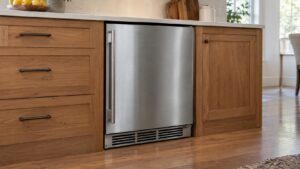
Because U-Line built-in refrigerators are installed within cabinetry to precise dimensions, replacement isn’t as simple as rolling a new unit into the kitchen — it typically means finding a comparably sized replacement that fits the existing cabinet opening, or accepting some cabinetry modification. This is worth weighing against repair, since a straightforward repair that resolves the issue may be considerably less disruptive than a full replacement process, even setting aside the refrigerator’s age.
Making the call
There’s no single rule that applies to every situation, but a useful mental framework is to ask three questions together: how old is the unit relative to typical refrigerator lifespan, is the current problem a simple component or a sealed-system issue, and has this unit needed repeated repairs recently. A newer unit with a simple, first-time problem almost always favors repair. An older unit with a sealed-system failure and a recent repair history leans toward replacement. Most real-world situations fall somewhere between those two extremes, which is exactly when getting a technician’s honest assessment of the specific problem — rather than guessing from age alone — becomes the most useful next step.
It’s also worth factoring in how the unit fits into your broader household needs today versus when it was originally installed. A built-in refrigerator that was sized appropriately for a smaller household years ago may simply no longer meet current storage needs, which is a legitimate reason to lean toward replacement even if the existing unit could technically still be repaired. Conversely, a unit that still comfortably meets your needs and has an otherwise clean repair history is a strong candidate for continuing to repair rather than replace, regardless of exact age.
Whichever direction you lean, get a clear, itemized explanation from a technician of exactly what failed and why, rather than a vague description of a refrigeration issue. Understanding the specific failure — whether it’s a simple, inexpensive part or a sealed-system component — gives you the clearest picture of whether repair genuinely makes sense for your particular situation.
U-Line refrigerators are built and documented by the manufacturer in Milwaukee. For official specifications and owner documentation, visit the manufacturer at u-line.com.