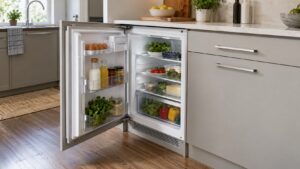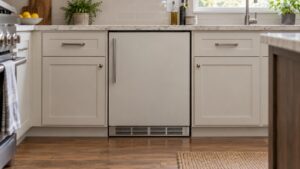
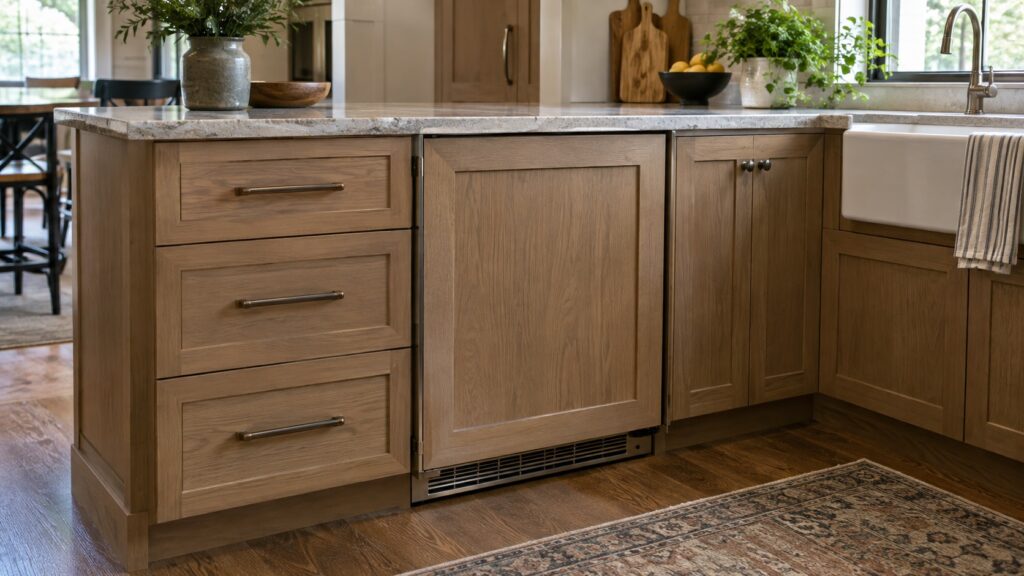
A U-Line panel-ready refrigerator is built to take a custom cabinet panel on its door so it disappears into your kitchen, while a stainless or glass-door U-Line stays visible as an appliance. Pick panel-ready when you want an unbroken run of cabinetry and are willing to plan the panel, the handle and the hinge clearances carefully; pick a finished door when you want the simplest install and the easiest service access.
What is the difference between panel-ready and stainless U-Line models?
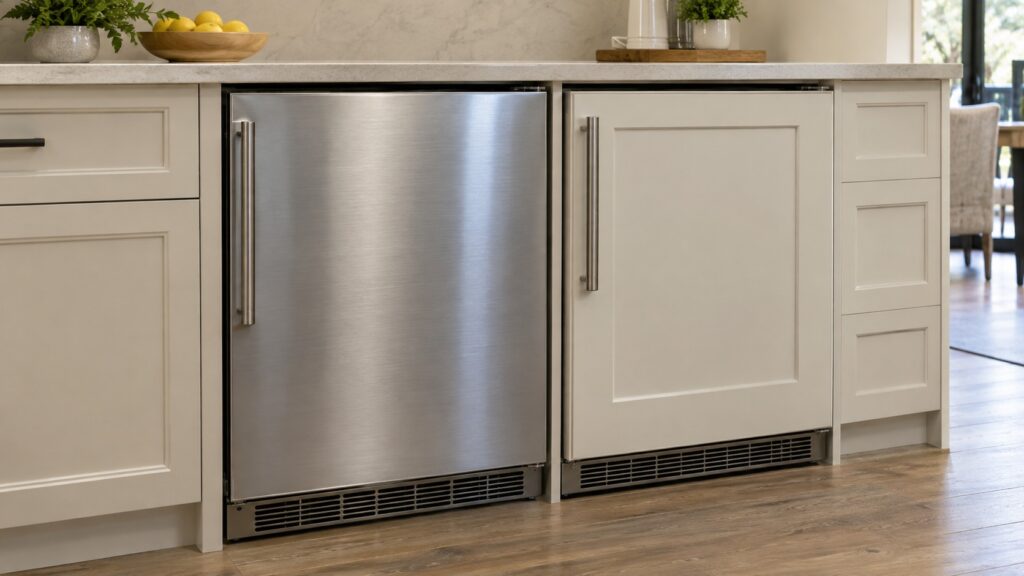
A panel-ready door is a frame that accepts a custom panel, usually made by your cabinetmaker to match the cabinets around it. The refrigerator itself is the same kind of cooling appliance, but the front is yours to design. A stainless or glass-door model arrives with a finished face, so there is nothing to build and nothing to match. In U-Line’s naming, the integrated models on our model list carry INT in the code, such as the U3036RRINT00B, and the glass-door model on the list is the U2224RGLS00B. Confirm the finish for any model by reading its data sheet, since the letters change over time and between sizes.
The choice is about design, not performance. A panel-ready unit and a finished unit of the same class and size cool the same way, so decide on how you want the room to look, then check the practical details below. Our 1 Class vs 3 Class vs 5 Class guide explains how the product lines differ, which is a separate decision from the finish.
What should you check before choosing a panel-ready unit?
Start with the panel. A custom door panel has a maximum thickness and weight set by the hinge, and a panel that is too heavy will sag, drag on the floor or pull the door out of alignment over time. Ask your cabinetmaker for the finished panel weight and compare it with the limit in the installation sheet. Next, check the handle. Many designers add a pull to the panel, and the handle must not collide with the neighboring cabinet or an appliance when the door swings open.
Then check the hinge clearance. A door that swings against a wall, a post or a drawer front cannot open fully, and a refrigerator drawer that cannot be pulled out is irritating to use. Leave the gap the installation sheet specifies, even if it looks wider than you would like. Our guide to installing an undercounter U-Line refrigerator explains clearances in detail.
How does service access differ?
A technician must reach the control panel, the condenser area and often the rear of the unit. With a finished-door model, removing the unit from its opening is straightforward. With a panel-ready model, the custom panel is part of the front and may have to be detached first, so ask your installer to attach it with a method that can be undone without damaging the cabinetry. Plan for the panel to be removed and refitted at some point in the life of the refrigerator. A little foresight at install time saves a long service visit later. You can read about our refrigerator repair service to see what a visit involves.
Which choice fits which kitchen?
Panel-ready suits a kitchen where the refrigerator is part of a long run of custom cabinets, such as a bar or a butler’s pantry. It also suits a space where a stainless box would look out of place. A finished stainless model suits a utility area, a garage bar or a family kitchen that wants to use the refrigerator without having to protect a panel. A glass-door model suits a bar where the contents are part of the display and the user wants to see what is cold.
- Choose panel-ready for a seamless cabinet run and a designer-planned kitchen.
- Choose stainless for a quick install and easy access.
- Choose glass for display, with attention to lighting and temperature.
- Choose an outdoor model if the unit will live outside, as covered in our outdoor collection buying guide.
Does the finish change the size or ventilation?
The size is set by the model, not by the finish, so use our undercounter refrigerator size guide to pick the width and height first. Ventilation, however, matters for every U-Line undercounter unit. Many front-breathing models draw air in and out through the grille at the bottom, and a custom panel or toe kick must not block that grille. Follow the installation sheet for the open area, and do not cover the grille with decorative trim. A blocked grille makes the compressor run hot, shortens its life and raises noise.
What if you are replacing an existing U-Line?
If the opening is already built, measure it carefully and match the width, height and depth to a model that fits. A panel-ready replacement needs a new panel, or the old panel needs to be transferred, which may not be possible if the hinge bracket differs. Take a photo of the existing arrangement and its model number before you order, and consider asking a technician to inspect the old unit first, since a repair may be a better option than a swap.
What is the simplest way to decide?
Ask three questions. Do you want the refrigerator to blend into the cabinets? Do you have a cabinetmaker who can build and hang the panel? Do you accept the extra planning? If the answer to all three is yes, panel-ready is the natural choice. If any answer is no, a finished stainless or glass model will give you the same cooling with less effort and a lower chance of a surprise on installation day.